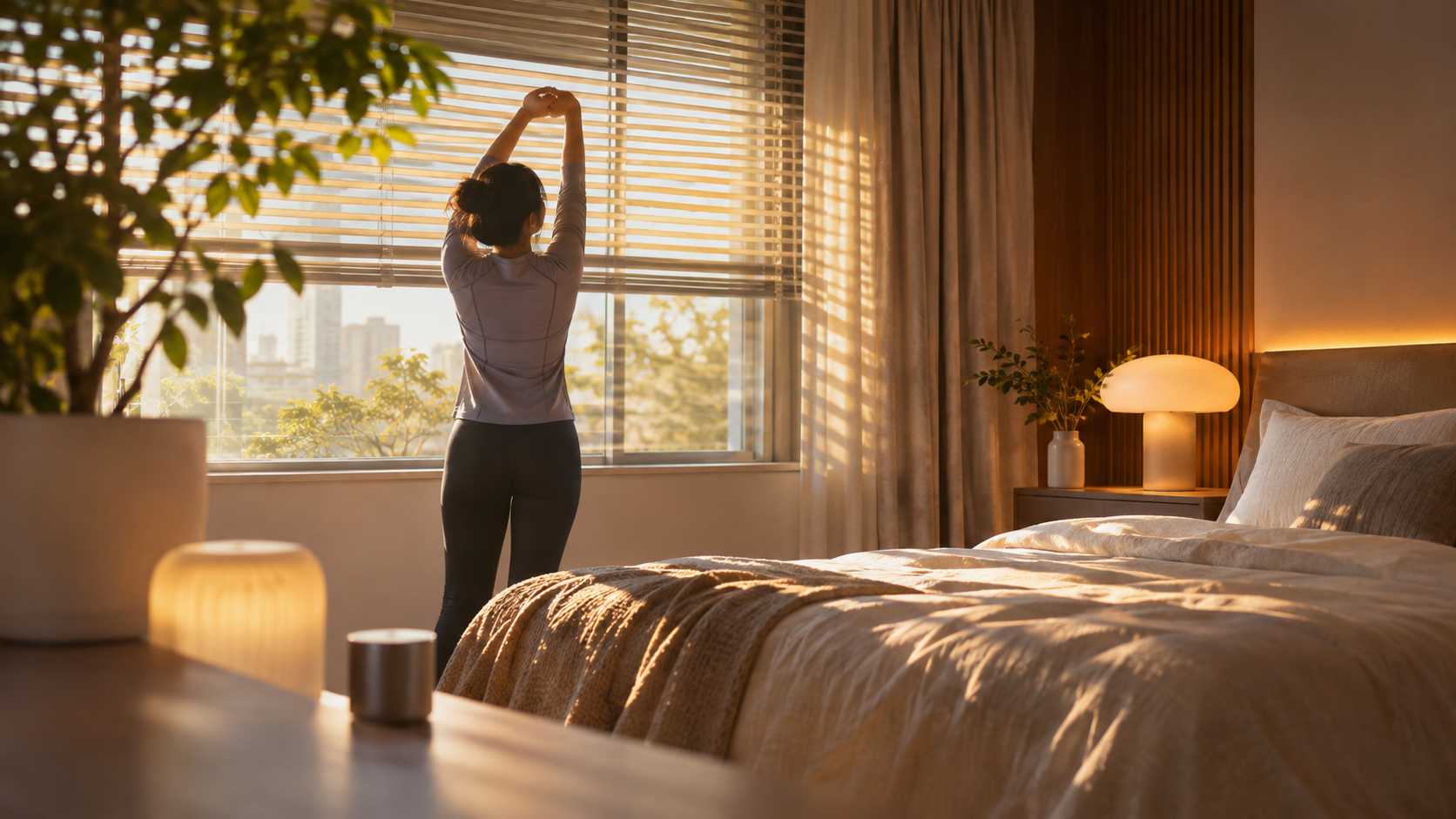
Choosing a light color for different times of day can make a room feel more useful and comfortable. A cooler, more neutral white can help a kitchen or desk feel alert and clear in the morning, while warmer light often creates a calmer atmosphere in the evening. But there is no single color temperature that is right for every person, room, or task. Brightness, glare, timing, fixture placement, and personal preference matter too.
This guide explains what color temperature means, offers sensible starting points for morning and evening, and shows how to set up smart lighting without treating it as a medical device. It also covers limitations, energy considerations, and how lighting fits into a broader smart-home setup.
What color temperature means
Color temperature describes the apparent color of white light, expressed in kelvins (K). In general, lower values look warmer, with more amber or yellow; higher values look cooler, with more blue or white. A candle-like source is very warm, while daylight can appear much cooler. The exact appearance also depends on the bulb, fixture, surrounding surfaces, and the other light sources in the room.
For everyday household lighting, a useful broad guide is:
- About 2,700–3,000 K: warm white, commonly used for relaxing spaces and evening ambience.
- About 3,000–4,000 K: neutral to slightly warm or cool white, often suitable for general activity, kitchens, and work areas.
- About 4,000–5,000 K: cooler white, which can make detail-oriented tasks feel visually crisp but may seem stark in a bedroom or living room.
These are practical ranges, not rules or health prescriptions. Manufacturers may describe the same range differently, and two products set to the same kelvin value can still look different. Color temperature also does not tell you how bright a bulb is: brightness is usually stated in lumens. Nor does it describe color rendering, which affects how faithfully objects appear under a light source.
What color temperature suits the morning?
For a morning routine, start with neutral white light, roughly 3,000–4,000 K, and adjust to the room and task. A kitchen used for breakfast and food preparation may feel clear at the neutral end of that range. A desk where you read or organize the day may benefit from a similarly neutral setting, provided the light is not glaring. If you prefer a warmer, gentler start, 2,700–3,000 K can be more comfortable, especially before sunrise or in a bedroom.
The more important design choice may be how and where the light reaches you. Use a diffuse ceiling light or several indirect sources rather than a bare, high-output bulb in your line of sight. Add a focused task light for reading, cooking, or grooming. If your smart system supports schedules, you can set the lights to come on gradually or change from warmer to more neutral over a chosen period. A schedule is a convenience, not a biological guarantee; people vary in their routines and responses to light.
Morning settings should also account for daylight. A bright, sunny room may need less electric light than a dim interior room. A sensor or manual dimmer can prevent the lighting from feeling unnecessarily intense. On a desk, position the lamp to reduce reflections on a screen and shadows on paper. In a kitchen, illuminate work surfaces without creating glare from glossy counters or appliance doors.
What color temperature suits the evening?
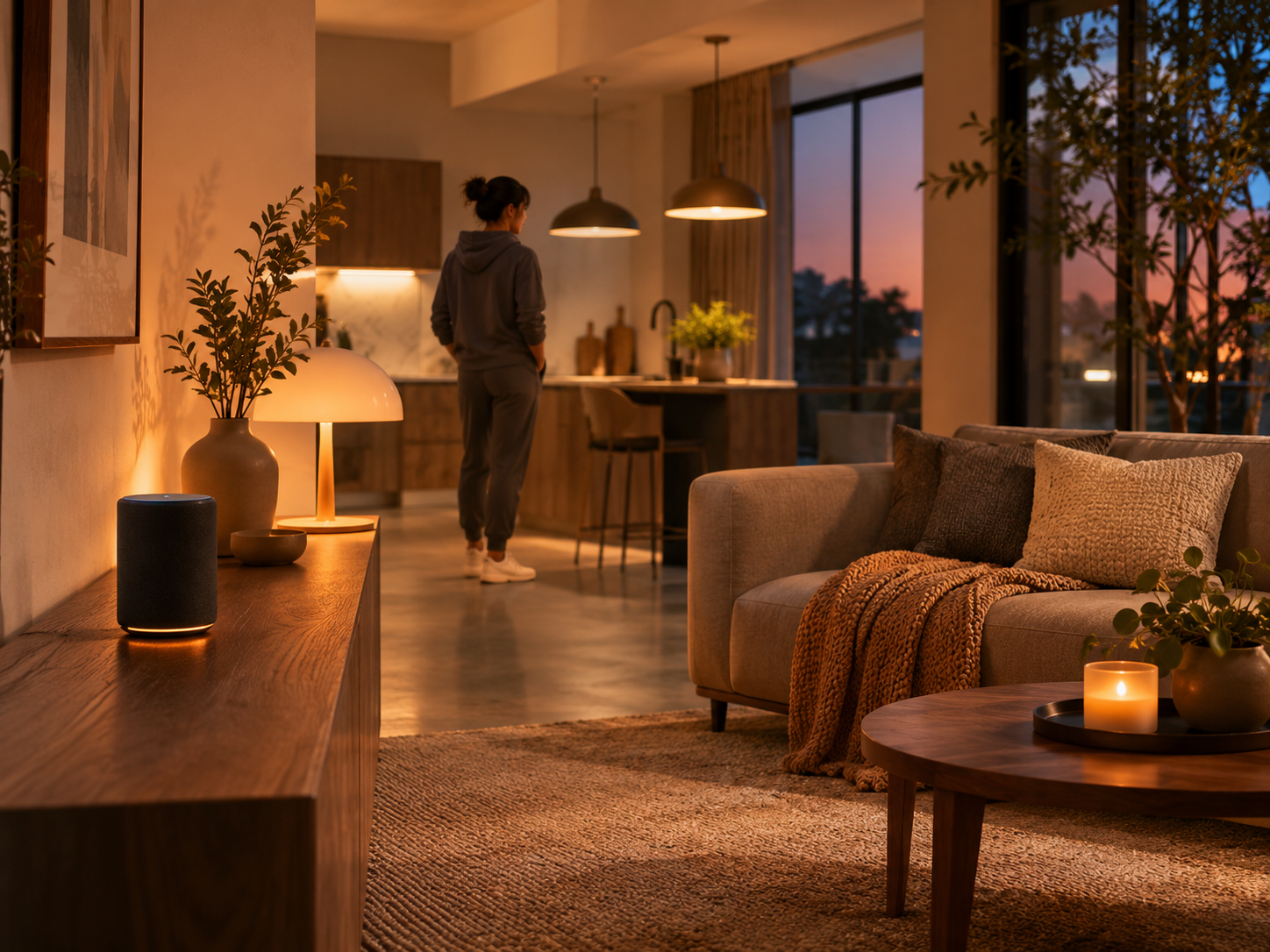
For a relaxed evening atmosphere, try warm white around 2,200–3,000 K. Many people find this visually softer than cooler white, and it often pairs well with lamps, wall lights, and low-level accent lighting. In a living room, separate the main light from reading or hobby lights so you can keep the room subdued while still seeing what you are doing. In a bedroom, a warm bedside lamp can make the space feel less like a work area.
Warm light is not automatically dim light, and warm settings do not eliminate glare. Lower the brightness when the task allows, aim light at a surface rather than directly at the eyes, and avoid strong contrasts between a bright fixture and a dark room. If you need to read, do detailed work, or safely manage stairs, use enough light for the task rather than choosing a very dim setting solely for its color.
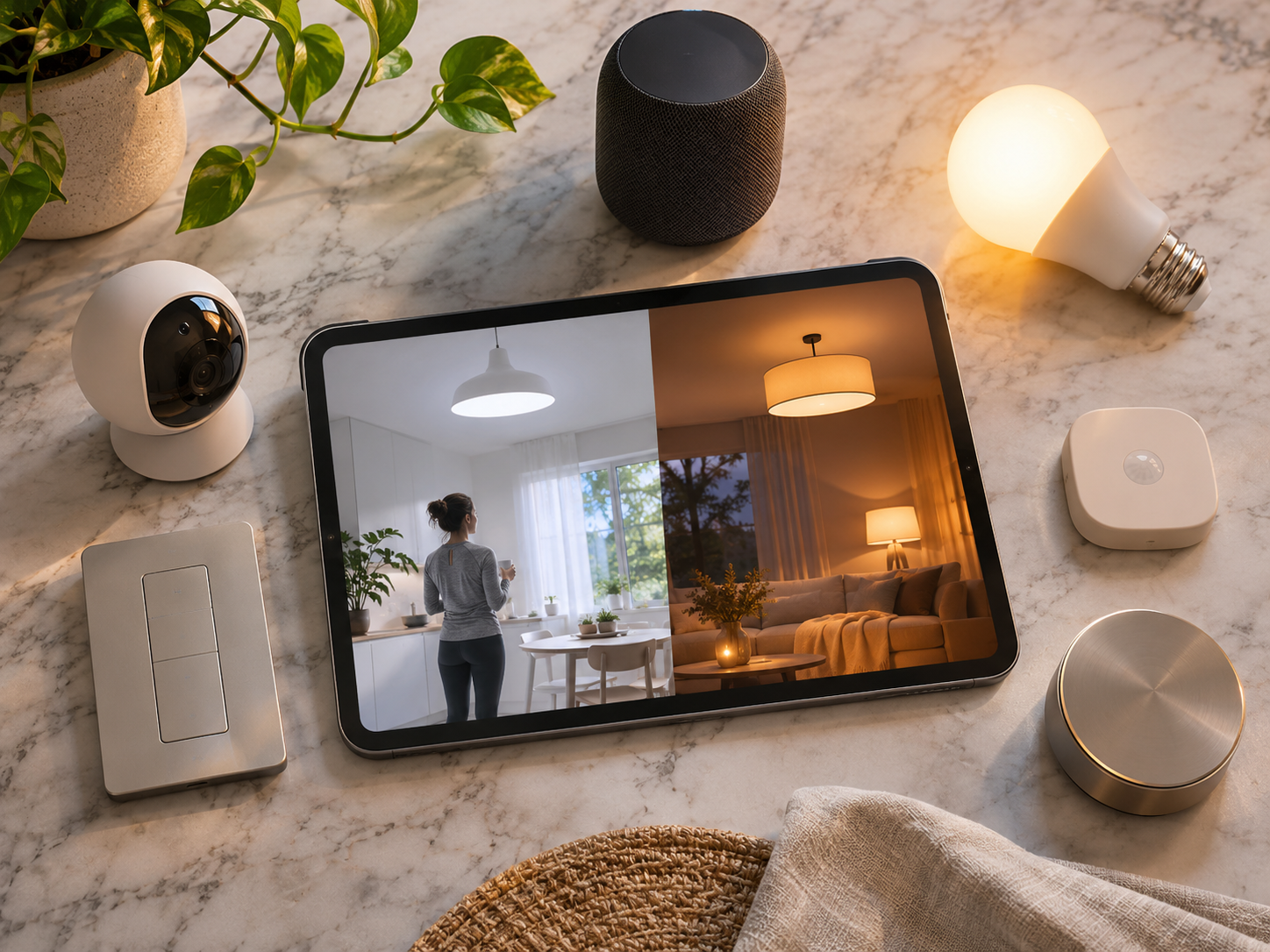
Smart bulbs and tunable-white fixtures can make this transition convenient: a scene might use a brighter neutral setting for household tasks and a warmer, dimmer setting later. Keep a manual control available for guests, children, and anyone who does not want to use an app or voice assistant. An automation that is confusing or unreliable is not a useful lighting plan.
A practical setup, room by room
1. Start with the activity
List what happens in each space. A kitchen may be used for food preparation, meals, and conversation; a bedroom may be used for dressing, reading, and sleep. Choose light for the task, not just the room label. Detail work generally needs adequate, well-directed illumination, while ambient lighting can be softer.
2. Check the existing light
Notice whether the room is naturally bright, where shadows fall, and whether the current bulbs create glare. Look at the light at the times you use the room. If daylight already provides much of the morning illumination, changing every bulb to a cooler setting may make little practical difference.
3. Choose a modest starting range
Try neutral white around 3,000–4,000 K for active morning areas and warm white around 2,200–3,000 K for evening ambience. Treat these as starting points. If your bulb has only preset scenes, test them in the actual room; a label such as “daylight” or “relax” is not standardized across brands.
4. Adjust brightness and direction separately
Use dimming to set brightness and aim or diffuse the fixture to control glare. A color change cannot compensate for a poorly positioned lamp. For a desk, consider a task lamp and screen reflections. For a bedroom, use a shaded bedside fixture rather than relying only on a bright overhead light.
5. Make schedules easy to override
If you use smart controls, create simple routines for the times you actually need them. Keep the schedule predictable and provide a physical switch or accessible control. Check what happens after a power or internet interruption, and confirm whether the bulbs retain their last setting or revert to a default.
6. Evaluate comfort over several ordinary days
Change one setting at a time. Notice whether the room feels comfortable for its intended use, whether colors look acceptable, and whether anyone finds the light too bright or too cool. Do not infer a health benefit from a pleasant-feeling setting. If a light causes discomfort, reduce brightness, change its position, or return to a setting that works for you.
How smart lighting fits into a smart home
Lighting can be coordinated with other systems, but integration should solve a real household problem. For example, a motion sensor may turn on a low-level hallway light at night, while a manual command controls the kitchen task lights. Linking lights to a security system can provide an occupancy-style lighting routine, but lighting alone does not secure a home. Locks, alarms, cameras, network reliability, privacy settings, and a household response plan all have separate roles.
Similarly, lighting schedules do not replace a thermostat schedule. A smart thermostat manages heating or cooling, while lighting controls lamps and fixtures. If an automation coordinates the two, check that it does not make temperature changes or switch lights in ways that waste energy or disrupt occupants. LED lighting generally uses less electricity than comparable older incandescent lighting, but actual savings depend on the products, usage, controls, and what they replace. Always-on smart devices also consume some power, and a connected bulb that is switched off at the wall cannot respond to an app.
In a minimalist desk setup, a tunable lamp can reduce the need to keep the entire room at the same brightness. In a bedroom, independent bedside controls can be more useful than a complex whole-home scene. In a kitchen, task lighting and easy-to-clean fixtures matter more than a feature-rich app. These are examples of choosing the simplest control that suits the space.
Evidence and design context
The named sources below provide useful context for lighting control and spatial design, but they do not establish one ideal morning or evening color temperature for every household.
Bluetooth SIG’s “Creating Healthier Spaces with Bluetooth Networked Lighting Control” discusses networked lighting controls and their role in adaptable indoor environments. It is relevant to how connected controls can coordinate lighting, but the article should not be read as proof that a particular consumer bulb setting prevents or treats a health condition.
Signify’s “Hospitality & Workspace Design” article considers lighting within designed hospitality and workplace settings. Commercial design priorities and controlled installations do not necessarily transfer directly to a home; household preferences, room size, daylight, and activities differ.
Stuff’s coverage of Philips Hue SpatialAware describes a product concept that treats lights as spatially arranged parts of a lighting system. This illustrates why placement and coordination can matter in addition to color temperature. It is product coverage, not independent evidence that spatial effects improve sleep, mood, or health.
The practical ranges in this guide are general lighting conventions, not the result of a comparative product test. No products were measured for this article, and the cited sources are not presented as clinical research. To compare bulbs, check the packaging or manufacturer specifications for kelvin range, lumens, dimming support, color rendering information, compatibility, and required hub or network. If possible, assess the light in the room where it will be used.
Pros and cons of tunable smart lighting
Potential advantages
- One compatible fixture can offer warmer and cooler white settings for different activities.
- Schedules, dimming, and grouped controls can make routine adjustments more convenient.
- Separate task and ambient lighting can support different uses of the same room without changing every fixture.
- Some systems can work with sensors or other smart-home controls, when those integrations are compatible and configured carefully.
Limitations and tradeoffs
- Compatibility varies: check bulb bases, dimmer requirements, wireless standards, hubs, and the platform you use.
- App, account, network, or cloud dependencies can affect setup and remote control. Some products retain basic local control; others offer fewer options when disconnected.
- Color quality and dimming behavior vary by product. Low settings may flicker or shift in color, so check the manufacturer’s specifications and test where possible.
- Connected bulbs can cost more than simple fixed-color bulbs, and replacing a working lighting system may not be worthwhile.
- Automation can be inconvenient when schedules do not match actual routines or when a wall switch cuts power to a smart bulb.
- Color temperature alone does not determine comfort, visual performance, sleep quality, or health outcomes.
Limitations and safety
Lighting preferences are personal, and color temperature is only one part of the experience. The same setting can appear different depending on the bulb, the room’s finishes, daylight, and the observer. People with light sensitivity or vision needs may require individual adjustments. This general information is not medical advice and does not establish treatment or prevention effects. For persistent eye discomfort, sleep concerns, or other health questions, consult an appropriate qualified professional.
For household safety, keep cords and lamps away from wet areas, heat sources, and places where they can be knocked over. Use bulbs within the fixture’s ratings, and do not install a connected bulb in an incompatible enclosed fixture or dimmer unless the manufacturer says it is suitable. Smart lighting is not a substitute for required smoke alarms, security equipment, safe stair lighting, or other safety measures.
Q&A
Is warm or cool light better in the morning?
Neither is universally better. Neutral white around 3,000–4,000 K is a reasonable starting point for active tasks; warmer light may feel more comfortable for a gradual start. Choose based on the room, daylight, task, and personal preference.
Should I use warm light in the bedroom at night?
Warm light around 2,200–3,000 K is a common choice for a relaxed bedroom atmosphere. Use enough brightness for reading and safe movement, and avoid direct glare. The setting is a comfort choice, not a guaranteed sleep intervention.
Do I need smart bulbs to change color temperature?
No. Fixed-color bulbs, dimmers, and lamps can provide suitable lighting without an app. Tunable bulbs are useful when you want adjustable white light, but only if their controls and compatibility fit your home.
What matters more: kelvins or lumens?
They describe different things. Kelvins indicate the apparent color of white light; lumens indicate light output. For a comfortable room, consider both, along with glare, fixture placement, and the task.
Bottom line
For many homes, neutral white around 3,000–4,000 K is a useful morning starting point for kitchens and work areas, while warm white around 2,200–3,000 K can create a gentler evening atmosphere. These ranges are flexible, not prescriptions. Set brightness and placement for the task, account for daylight, and make smart routines easy to override. A comfortable lighting setup is the one that works reliably for the people using the room.