
The best air quality sensors for home wellness tracking are the ones that measure the pollutants or conditions you actually need to monitor, report their readings clearly, and fit your household’s habits. A compact monitor can help you notice patterns, such as particles rising while cooking or carbon dioxide building up in a closed bedroom. It cannot diagnose illness, certify that a room is safe, or replace a smoke alarm, carbon monoxide alarm, or professional assessment.
This guide explains what home air sensors measure, compares several real products by their documented features, and offers practical steps for choosing and using one. The comparison is based on manufacturer product information and general guidance from the U.S. Environmental Protection Agency (EPA) and the U.S. Centers for Disease Control and Prevention (CDC), not independent laboratory testing or firsthand product trials. Models, features, and availability can change, so check current specifications before buying.
What is a home air quality sensor?
A home air quality sensor is an electronic device that detects one or more airborne substances or environmental conditions and displays or transmits readings. Depending on the model, it may measure particulate matter (PM), carbon dioxide (CO2), volatile organic compounds (VOCs), temperature, or relative humidity. Some devices connect to a phone app, smart-home platform, or an air purifier; others show readings on the device itself.
“Air quality monitor” is a broad product category, not a promise that the device detects every hazard. A monitor that measures PM2.5 does not necessarily measure CO2, and a CO2 reading does not reveal whether a room contains carbon monoxide. Match the sensor to the question you want answered rather than relying on a single overall score.
What should a home air monitor measure?
Particulate matter
PM2.5 refers to airborne particles with an aerodynamic diameter of 2.5 micrometers or smaller. Sources indoors can include cooking, candles, tobacco smoke, and particles entering from outdoors. Some consumer monitors use optical particle sensors: they estimate particle levels by observing how particles scatter light. Readings can be useful for identifying changes and comparing conditions over time, but they are not equivalent to a laboratory analysis. Humidity, particle type, placement, and device design can affect results.
PM10 monitoring may also be offered. It covers a larger particle size range and can be relevant to dust, but do not assume that a device measuring PM2.5 also measures PM10 unless its specifications say so.
Carbon dioxide
Indoor CO2 is commonly used as an indicator of how well occupied spaces are ventilated relative to the number of people present. It is not a complete measure of indoor air quality, and a reading alone does not identify the source of a problem. Outdoor CO2, room occupancy, building conditions, and sensor placement all affect interpretation. CO2 is also different from carbon monoxide (CO), a poisonous gas produced by incomplete combustion. A consumer air monitor is not a substitute for a listed CO alarm.
VOCs and formaldehyde
VOCs are a large group of gases that may come from products such as paints, cleaners, furnishings, and personal-care items. Many consumer devices report a broad VOC index or estimated total VOC level, rather than identifying individual compounds. A changing index can be a prompt to investigate, but it generally cannot tell you exactly which chemical is present or whether an exposure is hazardous. Formaldehyde-specific claims deserve particular scrutiny: check what the manufacturer says the sensor measures and how it validates that measurement.
Temperature and humidity
Temperature and relative humidity are useful context for interpreting comfort and managing moisture. A sensor can help you notice a room that is consistently damp or dry, but it cannot find a leak or diagnose mold. CDC guidance emphasizes moisture control as an important part of preventing mold growth. If you see water damage or visible mold, address the moisture source and seek appropriate advice rather than relying on a monitor alone.
Notable air quality sensors to compare
The products below illustrate different priorities rather than a universal ranking. Features are summarized from their manufacturers’ published descriptions; verify the exact model and regional version, since capabilities and integrations can differ.
AirGradient ONE: a multi-measurement option
AirGradient describes its ONE monitor as measuring PM2.5, CO2, VOCs, nitrogen dioxide, temperature, and humidity, with data available through its display and software ecosystem. This broad sensor set may suit someone who wants several readings in one device and is comfortable reviewing multiple measurements. Before purchase, check which data access, connectivity, and integration features are available for the particular version. As with any consumer multi-sensor product, a long list of measurements does not mean every reading is equivalent to a certified instrument.
Awair Element: a connected room monitor
Awair’s published Element specifications describe measurements that include PM2.5, CO2 equivalent, VOCs, temperature, and humidity. Its app-based presentation is designed to summarize indoor conditions. Confirm whether a displayed CO2 value is a direct CO2 measurement or an estimate derived from other sensor data; the distinction matters if ventilation tracking is your main goal. A summary score is convenient, but examine the underlying measurements and their definitions when making decisions.
IKEA VINDSTYRKA: a straightforward particulate-focused choice
IKEA lists VINDSTYRKA as a smart air quality sensor that measures PM2.5, temperature, and humidity, and can show a TVOC indication. It is intended to work with IKEA’s smart-home ecosystem. This may appeal to households already using compatible IKEA devices, but ecosystem compatibility and available functions should be checked for your region and hub setup. A TVOC indication should not be treated as identification of a specific chemical.
Aranet4 HOME: focused on CO2 and room conditions
Aranet describes Aranet4 HOME as a monitor for CO2, temperature, relative humidity, and atmospheric pressure, with an e-ink display and app connectivity. It is a focused choice for people chiefly interested in CO2 patterns in occupied rooms. It does not provide the same particle-monitoring coverage as a device with a PM sensor, so it is not a complete air-quality monitor for smoke or cooking particles.
How to choose the right sensor for your home
- Write down the question you want answered. For cooking-related particle changes, prioritize a monitor with PM2.5. For room ventilation patterns, look for a clearly specified CO2 sensor. For broad trends, a multi-sensor device may be useful, provided you understand what its VOC readings mean.
- Check sensor descriptions, not just the product score. Look for named measurements, units, update behavior, and whether values are direct measurements or estimates. Treat vague phrases such as “purity score” as summaries, not as a measurement method.
- Review calibration and maintenance guidance. Sensors may drift, require calibration, or have a service life. Read the manufacturer’s instructions for placement, cleaning, recalibration, and replacement. Do not assume a device will remain accurate indefinitely.
- Decide how you want to see the data. A clear on-device display can make a reading easy to check without opening an app. Apps may offer graphs and alerts, but check account requirements, privacy settings, connectivity, and whether core readings remain available if internet access is lost.
- Check smart-home compatibility carefully. If you want readings to trigger a purifier, fan, or notification, confirm that the exact model supports the platform and automation you use. Compatibility can depend on hubs, software versions, and regional availability.
- Consider the room and household. A bedroom monitor should be quiet, readable at night, and placed where it is not blocked. In a kitchen, avoid positioning it directly beside steam or a range hood unless the manufacturer recommends that location. In a home with children or pets, consider cables, placement stability, and privacy settings.
Practical steps for using an air sensor
1. Place it where people spend time
Follow the manufacturer’s placement instructions. In general, use a representative location in the room rather than placing the device right beside a window, exterior door, air vent, humidifier, purifier outlet, or cooking surface. Those locations can produce readings that reflect a local plume rather than the room as a whole. Keep the monitor unobstructed and away from direct sunlight or other heat sources when possible.
2. Let it establish a baseline
After setup, observe readings during ordinary routines for several days. Note when windows are open, how many people are in the room, whether cooking or cleaning is taking place, and whether heating or cooling is running. A pattern is often more informative than a single momentary spike. Avoid treating a consumer device’s color change or alert threshold as a universal health boundary.
3. Investigate changes with low-risk actions
If PM rises while cooking, use an effective range hood that vents outdoors when available, and consider reducing particle-generating cooking methods. If CO2 tends to rise in a crowded, closed room, increase outdoor-air ventilation when conditions and building systems allow. If a VOC index changes after using a product, review that product’s label and ventilation instructions. These actions address possible sources; a monitor itself does not remove pollutants.
4. Pair measurement with the right equipment
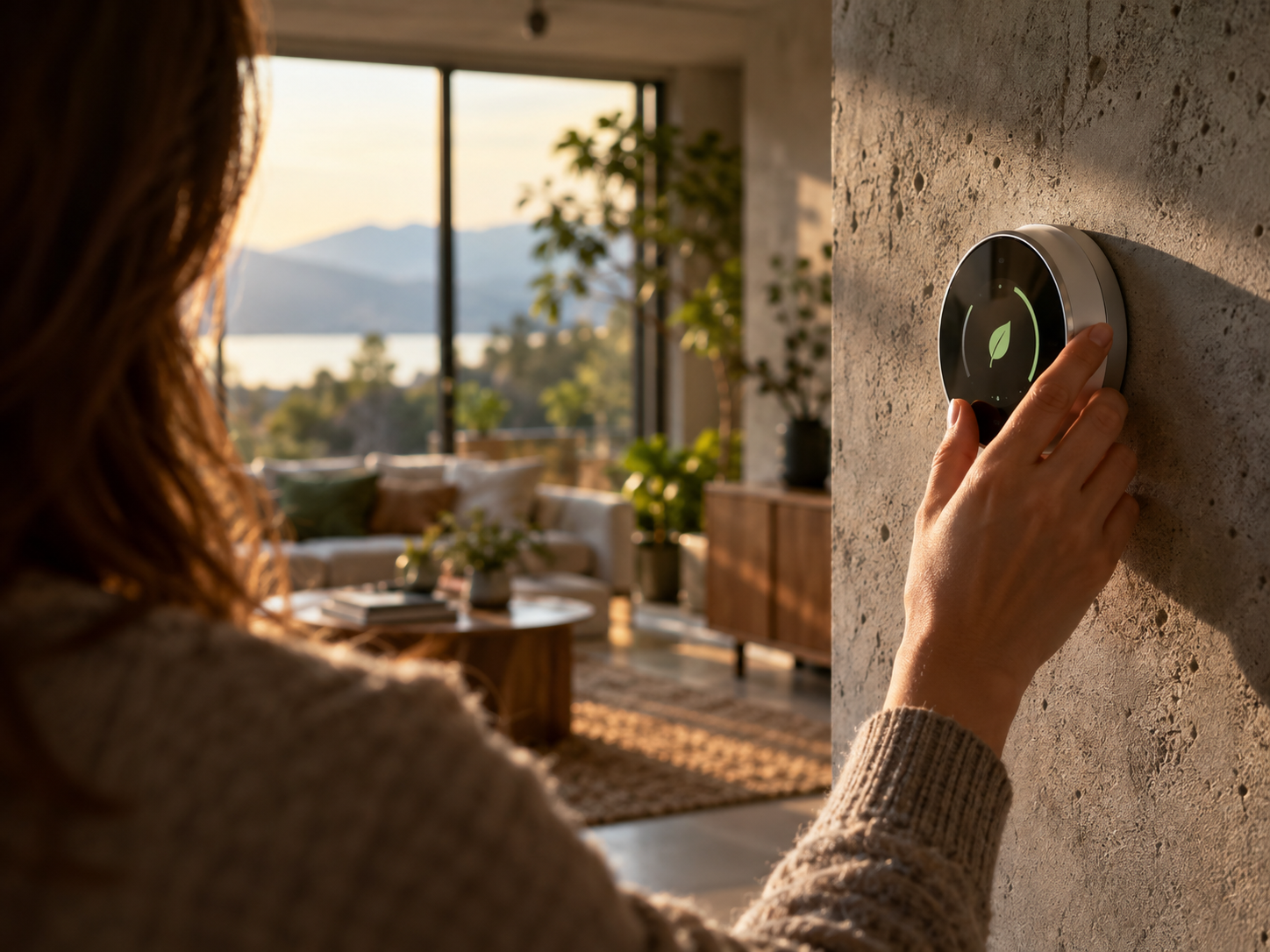
Air sensors can complement, but not replace, ventilation, source control, and appropriate filtration. A portable air cleaner with a suitable particle filter may help reduce airborne particles in its intended room; follow its sizing and maintenance instructions. A purifier with a particle filter may not remove gases unless it includes an appropriate gas-phase medium, and filters need replacement as directed. Smart thermostats can support scheduling and ventilation control in some systems, but they do not automatically improve air quality unless the connected equipment brings in or filters air.
5. Reassess after changes
Compare similar periods before and after an adjustment, such as running a range hood or changing purifier placement. Keep other conditions as consistent as practical. Sensor response and readings are affected by room layout and airflow, so use the comparison as household feedback rather than proof of a medical or engineering result.
Pros and cons of home air quality sensors
Potential benefits
- They can make invisible changes in particles, CO2, or humidity easier to notice.
- Time-series readings may help connect changes to cooking, occupancy, cleaning, or ventilation habits.
- Connected alerts and automations can make it easier to respond consistently, when supported and configured appropriately.
- Temperature and humidity readings provide context that can be useful alongside ventilation and moisture-management routines.
Limitations and trade-offs
- Consumer sensors vary in accuracy, calibration, response time, and the substances they can detect.
- A single device samples only its immediate environment; another room may have different conditions.
- VOC indices and composite air scores can conceal which measurement changed and may not identify a specific chemical.
- Alerts may cause unnecessary concern if thresholds are misunderstood, while a reassuring reading cannot rule out an unmeasured hazard.
- Apps, accounts, subscriptions, smart-home dependencies, and ongoing calibration or replacement needs may add complexity.
Common mistakes to avoid
Do not interpret a CO2 monitor as a carbon monoxide alarm, or a PM monitor as a smoke alarm. Install and maintain certified life-safety alarms according to local requirements. Do not assume that a low VOC index proves all chemicals are absent, or that a good composite score makes a room medically safe. Avoid placing a sensor directly in a purifier’s clean-air stream and then using that reading to represent the whole room. Finally, do not make major health or building decisions from one reading without considering the device’s limitations and the surrounding circumstances.
Concise Q&A
Which measurement matters most for a bedroom?
It depends on the concern. PM2.5 can help track particles; CO2 can provide a ventilation-related signal in an occupied room. Neither measurement alone describes overall air quality.
Can an air sensor tell me when to open a window?
It can offer context, but consider outdoor pollution, weather, safety, and the building’s ventilation system. A high indoor reading does not automatically mean opening a window is the best response.
Do I need a separate carbon monoxide detector?
Yes. Use a listed CO alarm as required by local codes and the manufacturer. A general air quality monitor is not a replacement unless it is specifically certified and labeled for that life-safety function.
Should I buy a monitor with the most sensors?
Not necessarily. Choose measurements that answer a real household question, and favor clear specifications and usable data over a long feature list.
Bottom line
The best air quality sensors for home wellness tracking are not necessarily the most expensive or feature-packed. Choose based on whether you need particle tracking, ventilation context, VOC trend indications, or a combination; then verify the sensing method, app requirements, calibration guidance, and smart-home compatibility. Use readings to spot patterns and guide sensible source-control or ventilation steps, not to diagnose health conditions or certify safety.
Safety and informational disclaimer: This article is general information, not medical, engineering, or environmental-health advice. Consumer monitors have measurement limitations and do not replace certified smoke or carbon monoxide alarms, professional testing, or advice from a qualified clinician or building specialist. If anyone experiences severe symptoms or you suspect an immediate hazard, leave the area and contact appropriate emergency services or professionals.
Sources and comparison method
Product feature descriptions were checked against the manufacturers’ published pages and documentation for AirGradient ONE, Awair Element, IKEA VINDSTYRKA, and Aranet4 HOME. For context on indoor air and consumer sensor limitations, consult the U.S. EPA’s guidance on air sensors and indoor air quality, and the CDC’s mold and moisture guidance. This is a feature-based editorial comparison, not a controlled performance test, endorsement, or claim that one product is more accurate than another.