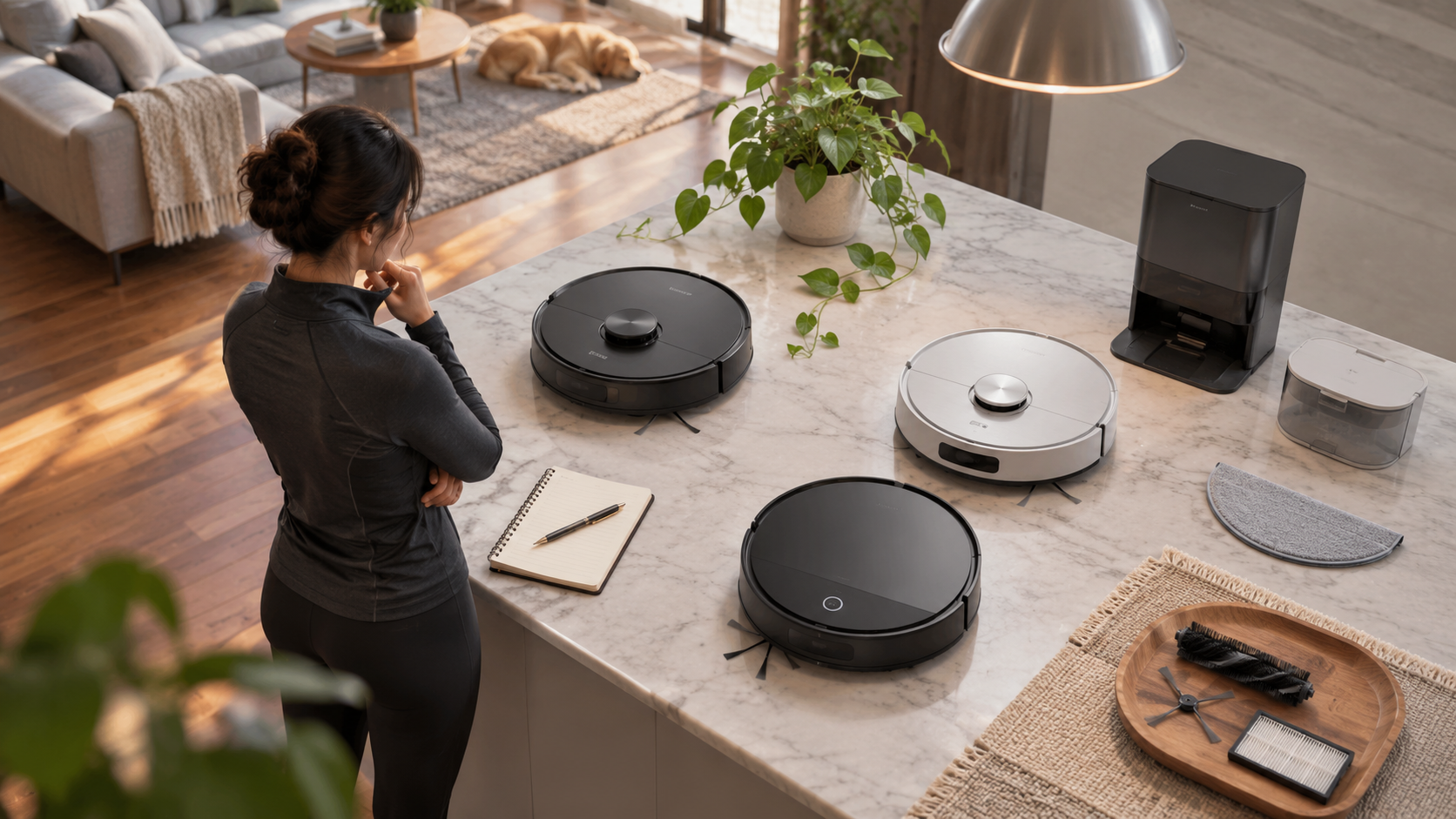
Choosing a robot vacuum for hardwood floors is less about finding the model with the biggest suction claim and more about matching its brushes, wheels, navigation and maintenance needs to your floors and home. A well-matched vacuum can collect dust, crumbs and pet hair between deeper cleans. The wrong one may scatter debris, struggle with rugs or require more upkeep than you expected.
This guide explains what to check before buying, how to compare features, and where robot vacuums have limits. It is intended for finished hardwood and similar hard surfaces; if your flooring is unsealed, newly finished or subject to a specific care warranty, follow the flooring maker’s instructions first.
What is a robot vacuum for hardwood floors?
A robot vacuum is an automated floor-cleaning device that moves around a room, collects debris into an onboard bin, and returns to a charging dock. Models vary in how they manage, what brush systems they use, how they handle edges and rugs, and whether they can also mop.
A hardwood-friendly model is not defined by one special certification. It is a vacuum whose manufacturer permits use on hard floors and whose design suits the floor’s finish, layout and debris. Look for floor-mode or suction controls, brush components that will not needlessly abrade the finish, wheels that roll cleanly, and navigation that avoids repeated collisions. Confirm all of this in the manual for the exact model.
Why hardwood floors need a considered choice
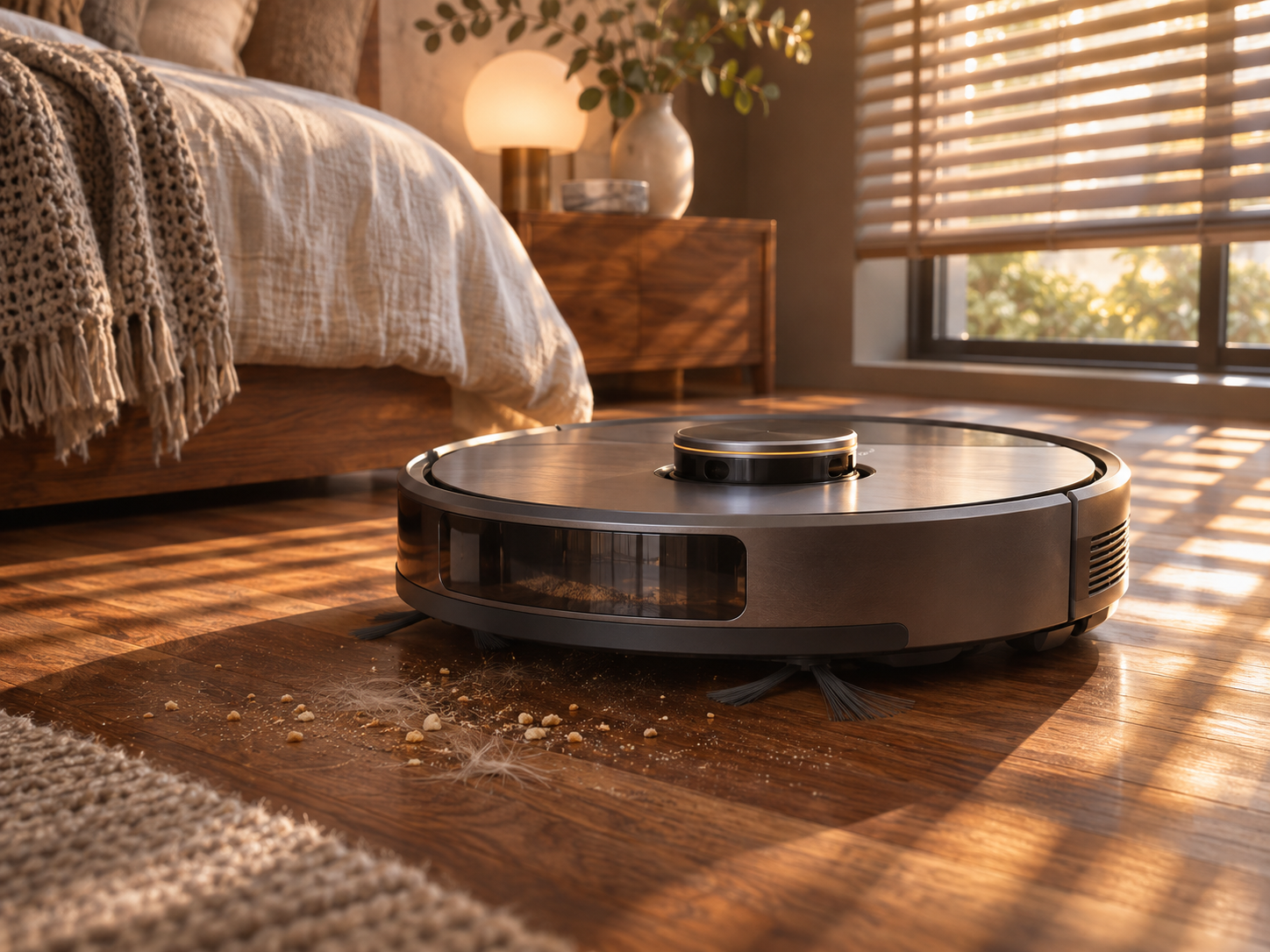
Finished hardwood is durable, but it is not immune to scratching or moisture damage. Fine grit dragged across a finish can act like an abrasive. A worn or dirty wheel, a tangled brush, or a small object caught beneath the robot can also mark the surface. Water is a separate concern: standing moisture can harm some wood floors, and care recommendations vary with the finish and installation.
That does not mean a robot vacuum is unsuitable. Regular removal of dust, hair and grit can make daily floor care easier. The goal is to choose a device that collects debris without aggressive contact, and to keep its brushes, wheels and sensors clean. If you have delicate, antique, waxed or unsealed flooring, ask the flooring professional or manufacturer whether a robot vacuum is appropriate.
How to choose a robot vacuum for hardwood floors
1. Check your floor type and care instructions
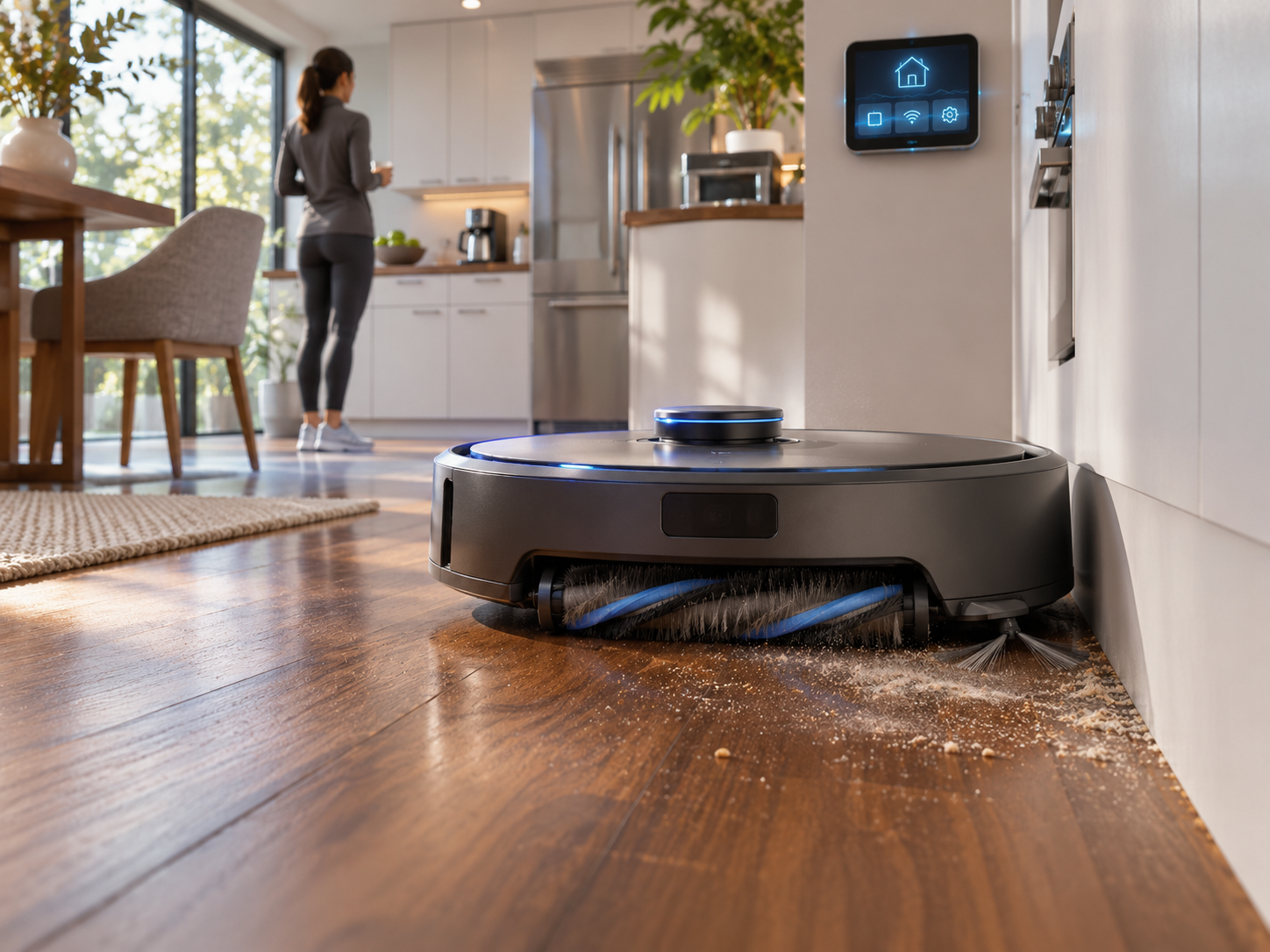
Start by identifying what you actually have: solid hardwood, engineered wood, laminate, bamboo or another surface. These materials may look similar but can have different care requirements. Find the flooring documentation if available, and check whether it limits vacuum attachments, damp cleaning or automated mopping.
Also note transitions between rooms, raised thresholds, floor vents, loose rugs and areas where cords or small objects collect. A robot that is suitable for a clear, single-level room may be a poor fit for a cluttered layout or a home with several tall transitions. Measure the tightest passages and check the robot’s listed dimensions and climbing limits against your home, rather than assuming it will clear every threshold.
2. Inspect the main brush and side brush
Brush design affects how a robot gathers debris and how much upkeep it needs. Many models use a central roller, often combining bristles and rubber elements. Others offer a soft roller or a hard-floor setting. No brush type is automatically safest for every finish: follow the maker’s floor guidance and inspect the roller for grit, tangled hair and wear.
A side brush can sweep dust from edges toward the intake, but it may also flick larger crumbs away from the robot. If scattered debris is a concern, look for adjustable side-brush behavior or a cleaning mode suited to hard flooring. Check whether replacement brushes are available and whether they can be removed without special tools. Regular inspection matters more than the feature label.
3. Look for useful suction and cleaning controls
More suction is not always more useful on a smooth floor. A practical model should collect everyday dust and debris without forcing you to use its loudest setting for every pass. Check whether the robot offers a hard-floor mode, adjustable suction or automatic surface detection. Read the manual to learn how those settings work; an advertised feature may behave differently across models.
Consider your typical mess. Fine dust, cereal crumbs and pet hair place different demands on the intake and brush. If you have pets, look at how easily hair can be removed from the roller and whether the manufacturer sells replacement parts. For frequent larger crumbs, see whether reviews and the manual indicate that the intake can pick them up without scattering them.
4. Match navigation to your floor plan
Basic robots may move in a less predictable pattern, while other models map rooms and follow planned routes. Mapping can make it easier to clean selected rooms, set boundaries or avoid a delicate area. It does not guarantee that the robot will recognize every cable, toy or low object, so tidy the floor before a run.
Check how the robot handles dark rugs, reflective surfaces, narrow gaps and furniture with low clearance. Sensors differ, and a device may fail to detect a small obstacle or may treat a dark surface as a drop-off. If the robot uses cameras or stores maps in an app, review its privacy information and settings before connecting it to your home network.
5. Evaluate wheels, bumping and edge behavior
Wheels should be clean and free of debris. Look for a design that allows you to inspect and maintain them, and avoid running the robot when a wheel is visibly dirty or damaged. Soft bumpers can reduce the force of contact, but they do not prevent every mark or collision. A careful first run while you are home is a sensible way to observe how the robot interacts with furniture and floor transitions.
Edge cleaning also varies. Some robots use a side brush to reach along baseboards; others may leave a narrow strip that needs occasional manual attention. If your home has fragile furniture legs, floor-level decor or dangling curtains, use app boundaries where available or remove the hazard rather than relying on obstacle avoidance alone.
6. Treat mopping as an optional feature
Combo vacuum-and-mop robots can be convenient, but mopping is not essential for hardwood and should not be treated as a substitute for floor-care guidance. Before using one, confirm that your floor manufacturer permits damp cleaning and that the robot’s instructions allow the floor type. Use only approved cleaning solutions, if any. Do not assume that a setting described as gentle is suitable for every wood finish.
Some models use a removable pad; others manage water electronically. In either case, avoid leaving a wet pad in contact with the floor, and do not allow moisture to pool. If the floor maker advises against wet cleaning, choose a vacuum-only model or keep the mop function disabled. Steam cleaning is not a safe default for hardwood.
7. Compare the dock, bin and ongoing upkeep
A small onboard bin may need frequent emptying, especially in a home with pets or heavy shedding. A self-emptying dock can reduce hands-on bin emptying, but it takes more space, can make noise, and may require replacement bags or other consumables. Check the dock’s dimensions and clearance requirements before buying.
Review the maintenance schedule in the manual. Hair can wrap around rollers and axles; dust can cover sensors; and filters need cleaning or replacement. A robot that is easy to open and maintain may be a better everyday choice than one with a longer feature list but hard-to-access parts. Check the availability and cost of consumables before committing, since ongoing costs vary by model and region.
8. Consider app features, noise and scheduling
Room selection, no-go zones and schedules can make a robot easier to fit into household routines. Decide which features you will actually use. If you prefer not to manage another app, choose a model with useful physical controls and straightforward automatic cleaning. If connected features matter, check whether the app requires an account and what permissions it requests.
Noise is worth considering if the robot will run while people are working, sleeping or using a shared space. Manufacturers may list noise information, but the sound you hear depends on the surface, cleaning mode and room. If possible, check independent reviews for descriptions of sound and routine usability, while remembering that a reviewer’s home may differ from yours.
Pros and cons of robot vacuums on hardwood
Potential advantages
- Scheduled cleaning can help keep loose dust, hair and everyday debris from building up between manual cleans.
- A compact robot can reach under some furniture that is awkward to clean with a full-size vacuum.
- Room mapping and boundaries can make recurring cleaning more convenient in a suitable layout.
- Vacuum-only models avoid adding moisture to floors where damp cleaning is discouraged.
Trade-offs
- Robots may miss corners, edges, tight spaces and debris caught in floor gaps.
- They need routine maintenance, including brush, wheel, bin, filter and sensor care.
- They can get stuck on cords, rugs, thresholds or small objects, and obstacle detection is not infallible.
- Self-emptying docks, mapping features and mop functions can add cost, space needs or app complexity.
- A robot is not a replacement for occasional detailed cleaning or for addressing spills promptly.
Common limitations to understand
A robot vacuum is designed for maintenance cleaning, not every cleaning job. It may not lift stuck-on residue, clean stairs, reach high shelves or remove grime along every edge. It can also struggle with long fringe, loose cables, very thick rugs and low furniture. These limitations vary by model, so check the manual and test the robot in a supervised area before setting a recurring schedule.
Dust collection is not the same as air purification. A robot vacuum may stir up some particles while operating, and its filter performance depends on the design and maintenance. If indoor air quality is a concern, consult the vacuum’s filtration specifications and consider a separately sized air purifier; do not assume a robot vacuum is a health device.
Finally, a robot can only clean what it can safely reach. Pick up small objects, secure cords and remove pet waste before a run. Keep the dock and charging cable positioned as instructed, and stop using the unit if it is damaged, overheating or behaving unusually.
A simple buying checklist
- Confirm that the floor maker permits the planned vacuuming method and, if applicable, mopping.
- Check brush design, floor settings, wheel access and replacement-part availability.
- Compare the robot’s dimensions and threshold guidance with your doorways, rugs and furniture.
- Choose navigation and app features that suit your layout and privacy preferences.
- Review bin capacity, dock footprint, consumables, maintenance steps and warranty terms.
- On the first run, supervise the robot and inspect the floor and its wheels afterward.
Sources and comparison method
This guide uses a practical comparison method rather than claiming a laboratory ranking: compare the exact model’s user manual, manufacturer specifications, care and warranty terms, and replacement-part information with the requirements of your flooring. For general hardwood care, consult the National Wood Flooring Association and Bona’s hardwood-floor care guidance, then give priority to the instructions for your own floor’s finish and the robot’s manual. Product features and recommendations can change, so verify current documentation before purchase.
Q&A
Are robot vacuums safe for hardwood floors?
They can be suitable for many finished hardwood floors when the manufacturer permits hard-floor use and the robot is kept clean and maintained. No model is guaranteed scratch-proof. Check your floor-care instructions and inspect brush rollers and wheels regularly.
Is a soft roller always better for hardwood?
No. Brush materials and designs differ, and suitability depends on the floor finish, debris and manufacturer guidance. Compare the model’s manual and maintenance requirements rather than choosing by brush name alone.
Should I buy a vacuum-and-mop robot?
Only if your floor maker permits the robot’s type of damp cleaning and you are willing to manage the pad and water system. If moisture is not appropriate for your floor, use a vacuum-only model or leave mopping disabled.
How often should a robot vacuum run?
There is no schedule that suits every home. Set it according to how quickly dust, crumbs or pet hair accumulate, and check the floor after initial runs. Reduce frequency or change settings if the robot repeatedly disturbs rugs, gets stuck or leaves marks.
Final takeaway
To choose a robot vacuum for hardwood floors, prioritize floor-care compatibility, manageable brushes and wheels, reliable navigation for your layout, and simple maintenance. Treat mopping as conditional, not automatic, and check the product manual before relying on any feature. A well-chosen robot can make routine upkeep easier, but it works best as one part of a careful floor-cleaning routine.
Informational disclaimer: This article is general buying and care information, not a guarantee that a particular device is suitable for your floor. Follow the flooring manufacturer’s instructions and the robot’s safety manual; when in doubt, ask a qualified flooring professional.