Learning how to create a smart home lighting plan is less about filling every room with connected bulbs and more about deciding what each space should help you do. A good plan supports daily routines, improves comfort, saves energy, and adds atmosphere without making the home feel complicated. It should also work when the internet is unavailable, guests do not understand the controls, or someone simply wants to use a regular wall switch.
Smart lighting can coordinate with security systems, smart thermostats, bedroom gadgets, kitchen appliances, and home wellness devices. Yet the best results start with a simple foundation: effective light placement, suitable color quality, reliable controls, and scenes that match real activities. Use the following process to design a lighting system that feels calm, practical, and personal.
Start With the Way You Use Each Room
Before choosing bulbs or switches, write down the main activities in every room. A living room may need bright light for cleaning, softer light for conversation, focused light for reading, and a low-level path light for late-night movement. A kitchen may need shadow-free task lighting over worktops, ambient light for dining, and cabinet lighting that makes storage easier to manage.
This activity-first approach prevents a common mistake: installing one bright ceiling fixture and expecting it to serve every purpose. Smart controls cannot correct poor fixture placement. They can only make a suitable lighting system easier to adjust.
Make a Room-by-Room Lighting List
For each space, note four things:
- Tasks: What activities require clear, concentrated light?
- Atmosphere: Should the room feel lively, restful, intimate, or flexible?
- Safety: Where are steps, thresholds, hallways, and dark corners?
- Routine: Which lights should respond to schedules, occupancy, or time of day?
Include transitional areas such as stairs, entrances, corridors, and bathrooms. These locations often benefit from gentle automation because people use them while carrying items, waking at night, or arriving home with limited visibility.
Build Layers Instead of Relying on One Fixture
A comfortable lighting plan usually contains three layers: ambient, task, and accent lighting. Smart technology is most useful when each layer can be controlled separately.
Ambient Lighting
Ambient lighting provides general visibility. It may come from ceiling fixtures, recessed lights, wall lights, or several lamps distributed around a room. Keep this layer even and comfortable rather than excessively bright. Multiple modest sources often feel more natural than one powerful fitting.
Task Lighting
Task lighting supports specific activities. Examples include under-cabinet strips for food preparation, a desk lamp for computer work, reading lights beside a bed, and mirror lighting in a bathroom. Position task lights to reduce shadows and glare. A smart bulb cannot make a badly positioned lamp comfortable, so test the angle from the user’s normal position.
Accent and Decorative Lighting
Accent lighting draws attention to artwork, shelving, architectural details, plants, or textured materials. Decorative lamps also contribute to the character of a room. These sources can be dimmed independently to create atmosphere without leaving the whole room underlit.
Layered lighting connects naturally with home decor and furniture. A sideboard can host a small lamp, open shelving can use discreet lighting, and a reading chair can have its own focused source. Plan wiring and outlet access around the furniture layout so the room remains visually tidy.
Choose the Right Smart Lighting Technology
There are three common ways to make lighting smart: smart bulbs, smart switches, and smart plugs. Each has a place in a well-planned home.
Smart Bulbs
Smart bulbs are useful when you want color temperature changes, color effects, individual lamp control, or installation without changing the wall switch. They work well in table lamps, floor lamps, decorative fittings, and rooms where different bulbs need separate control.
The main limitation is power. A smart bulb must remain connected to electricity, so turning off its physical switch can make it unavailable. This can confuse visitors and household members unless the controls are clearly labeled or the switch is protected from accidental use.
Smart Switches and Dimmers
Smart switches are often the better choice for permanent ceiling fixtures and groups of lights. They preserve familiar wall control while adding schedules, scenes, remote access, and automation. Smart dimmers are particularly useful in living rooms, dining areas, bedrooms, and hallways.
Check electrical compatibility before buying. Some dimmers require a neutral wire, a minimum load, or specific LED compatibility. Homes with older wiring may need an electrician to assess the installation. A switch that supports local manual control is preferable for essential lighting.
Smart Plugs
Smart plugs can control lamps that do not need dimming or color adjustment. They are practical for simple on-and-off automation, but they should be used within their electrical rating and in suitable locations. Avoid using a smart plug as a substitute for a proper lighting control when you need dimming, a wall switch, or a permanent installation.
Plan Color Temperature and Light Quality
Color temperature affects how a room feels and how useful the light is. Warmer light generally suits relaxing areas, bedrooms, dining rooms, and evening scenes. A more neutral or cooler setting can support focused work, cleaning, and detailed kitchen tasks. You do not need different color temperatures everywhere; consistency within connected sightlines is often more important.
Look for bulbs with good color rendering so furniture, food, clothing, and skin tones appear natural. This matters in kitchens, bathrooms, dressing areas, and rooms with artwork. If you use adjustable white bulbs, create a small number of dependable settings instead of constantly changing the color. A warm evening setting, a neutral daytime setting, and a brighter cleaning setting may be enough.
Use colored light sparingly. It can add character to a media room, party scene, or children’s space, but it is rarely the best primary light for everyday living. Neutral, well-rendered white light gives a home a more flexible base.
Connect Lighting With Daily Routines
Scenes combine several lights and settings into one command. Useful scenes are tied to a real activity rather than a technical feature.
- Morning: Gradually raise bedroom and hallway lighting, then provide brighter neutral light in the kitchen.
- Work: Turn on desk and task lighting while keeping surrounding ambient light comfortable.
- Relax: Dim overhead fixtures and leave selected lamps or accent lights on.
- Movie: Lower the main lights while retaining safe pathway lighting.
- Night: Use low-level, warm lighting for bathrooms, stairs, and corridors.
- Away: Turn off unnecessary lights and activate selected presence-based or scheduled lights.
Use schedules for predictable events and sensors where behavior varies. A hallway motion sensor can be useful at night, while a dining-room scene may be better activated manually. Avoid automating every light based on occupancy. Frequent unexpected changes quickly become irritating.
Coordinate Lighting With Security and Energy Controls
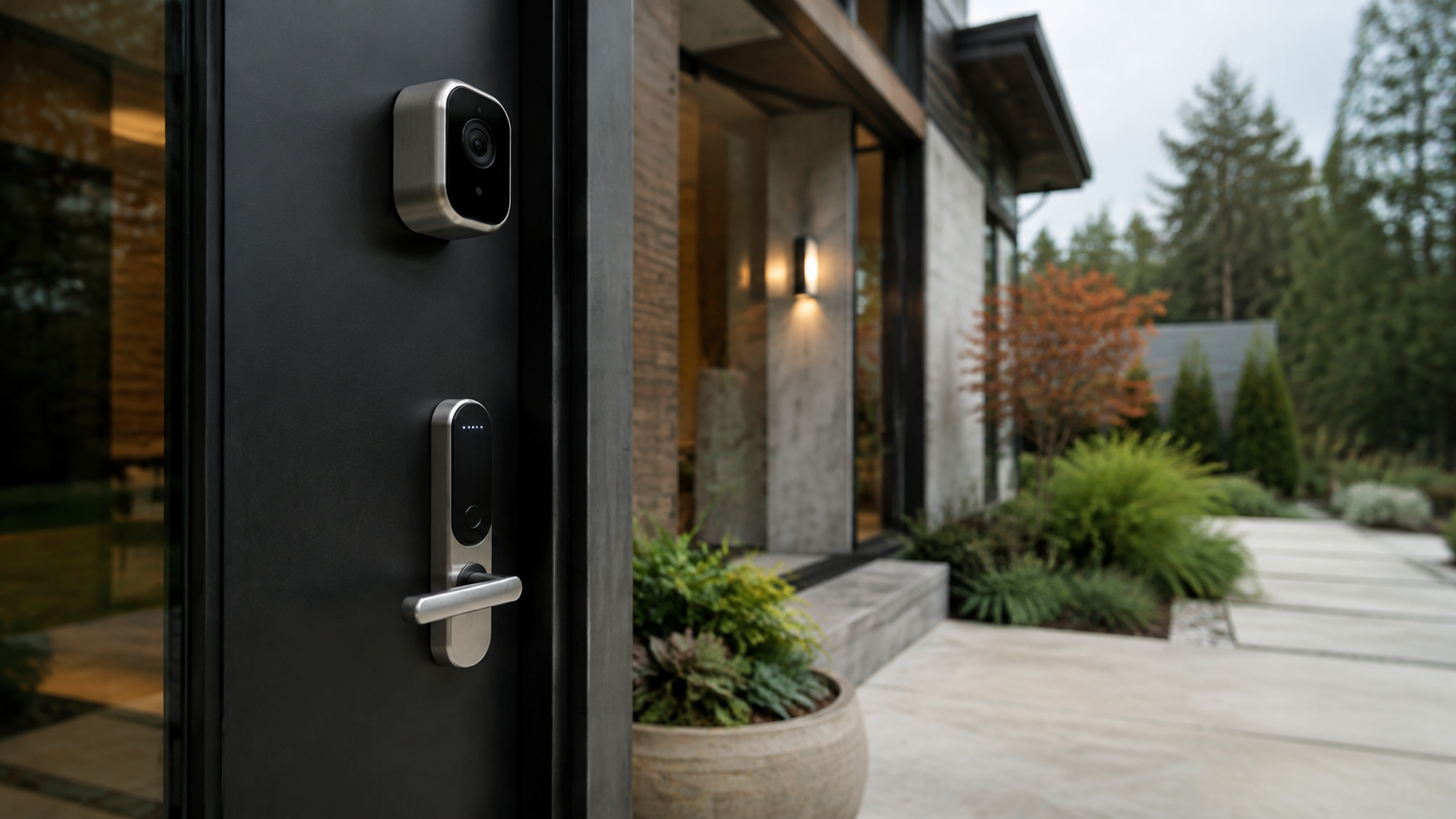
Smart lighting can support smart home security systems, but it should complement physical security rather than replace it. Entry lights can turn on when a door sensor detects an arrival, porch lights can follow a schedule, and selected interior lights can create a lived-in pattern while the household is away. Configure these features carefully so lights do not react to every minor notification or create an obvious repeating pattern.
Use outdoor fixtures rated for outdoor conditions and position them to illuminate paths, locks, and steps without shining directly into windows or neighboring properties. Motion activation should provide enough time for someone to enter safely without leaving lights on unnecessarily.
Lighting also works with smart thermostats and energy management. Schedules can turn off lights in empty rooms, while daylight sensors can reduce artificial light when windows provide enough illumination. These automations are most effective when they are predictable and adjustable. Energy savings should not come at the cost of unsafe stairs, difficult kitchen work, or excessive switching that shortens the useful life of components.
Design for Bedrooms, Desks, and Wellness
Bedrooms benefit from low-glare, controllable lighting. Place reading lights where they can be operated from bed, and keep a separate low-level path light for nighttime movement. A gradual wake scene may feel more comfortable than a sudden bright ceiling light. Avoid direct light aimed at the pillow, and consider blackout curtains if exterior lighting affects sleep.
Minimalist desk setups need layered control too. A task lamp should illuminate documents and the keyboard without reflecting strongly on a monitor. Add soft ambient light behind or beside the screen area to reduce harsh contrast, while keeping the desk surface clear. A work scene can activate the task lamp and neutral ambient light; a video-call scene can provide even light from in front of the user rather than from overhead.
Home wellness extends beyond brightness. Light should support calm movement, clear visibility, and a comfortable evening transition. Coordinate gentle bathroom, stair, and hallway lighting with air purifiers, ventilation, or other wellness devices only when the automation is easy to understand. A quiet home experience depends on reducing friction, not adding more notifications and controls.
Include the Kitchen and Cleaning Zones
The kitchen deserves careful planning because it combines detailed work, food presentation, social activity, and cleaning. Under-cabinet lighting should cover the usable worktop and be placed toward the front of the cabinet where possible. Check for glare on polished counters and appliances. Pantry and cabinet sensors can be helpful, but manual controls should remain available.
Set a bright, neutral kitchen task scene for chopping and cooking, a softer scene for meals, and a full-light scene for cleaning. Integrate lighting with kitchen appliances and organization only where the connection has a clear benefit. For example, a scheduled evening scene can illuminate the area around a coffee station, while cabinet lighting can make frequently used storage easier to find.
Robot vacuums and cleaners also affect lighting decisions. Keep floor-level lights and charging areas visible enough for safe access, and avoid placing cords where a cleaning robot can catch them. A low-level evening scene can help people spot obstacles without illuminating the entire room.
Prioritize Reliability, Privacy, and Accessibility
Choose a smart home platform that supports the devices you need and has a control method your household will actually use. Check whether devices communicate through Wi-Fi, Bluetooth, Zigbee, Thread, or another standard, and confirm hub requirements before purchasing. Compatibility can change, so review current manufacturer documentation rather than relying on a product label alone.
Essential lights should still work manually. Consider local control for entrances, kitchens, bathrooms, stairways, and bedrooms. Keep a basic fallback plan for network outages, including physical switches and sensible default brightness levels.
Review privacy settings for motion sensors, cameras, voice assistants, and cloud-connected services. Use strong account security and separate guest access where supported. For accessibility, provide large, clear switches, voice control only as an optional layer, and scenes that reduce the need to reach for small controls. A smart home should be usable by someone who has never opened the app.
Test the Plan Before Expanding It
Install or configure one room first. Observe it at different times of day and from different seating positions. Look for glare on screens, dark work areas, slow responses, confusing switch behavior, and scenes that are too bright or too dim. Ask another household member to use the controls without an explanation. Their experience will reveal whether the system is intuitive.
Label controls by purpose rather than by device name. “Evening,” “Cooking,” and “All Off” are easier to understand than a list of technical bulb identifiers. Keep an all-off control near the main exit, but exclude safety-critical or security-related lights if turning everything off would create a problem.
Once the first room works reliably, expand one zone at a time. This makes troubleshooting easier and prevents a large collection of incompatible devices. Record model numbers, installation notes, and reset instructions in a household document so future maintenance does not depend on one person’s memory.
Q&A
What is the first step in creating a smart home lighting plan?
Start by listing the activities, safety needs, and preferred atmosphere for each room. Then map ambient, task, and accent lighting before selecting smart devices.
Are smart bulbs or smart switches better?
Smart bulbs are flexible for lamps, color control, and individual fixtures. Smart switches are usually better for permanent ceiling lights because they preserve familiar wall control and can operate groups of fixtures.
Should every light be automated?
No. Automate predictable routines and repetitive safety tasks, but keep manual control for areas where people want immediate choice. Too much automation can make a home feel unpredictable.
Can smart lighting reduce energy use?
It can help by turning off unused lights, responding to daylight, and following schedules. Efficient fixtures and sensible brightness still matter more than connectivity alone.
How can lighting support a minimalist home?
Use fewer, better-positioned fixtures, conceal cables where practical, and create a small set of clear scenes. The system should reduce visual clutter and daily effort rather than add another complicated layer.
A Lighting Plan That Ages Well
The strongest smart lighting plan is flexible without being dependent on novelty. It gives each room the right types of light, keeps important controls available locally, and uses automation to support routines that already make sense. By coordinating lighting with security, energy, furniture, kitchen organization, bedroom comfort, and home wellness, you can create a connected home that feels natural at every hour.
Begin with one room, test the experience, and expand only when the controls and hardware prove reliable. Good smart lighting is rarely about having the most features. It is about making the right light appear in the right place, at the right time, with as little effort as possible.