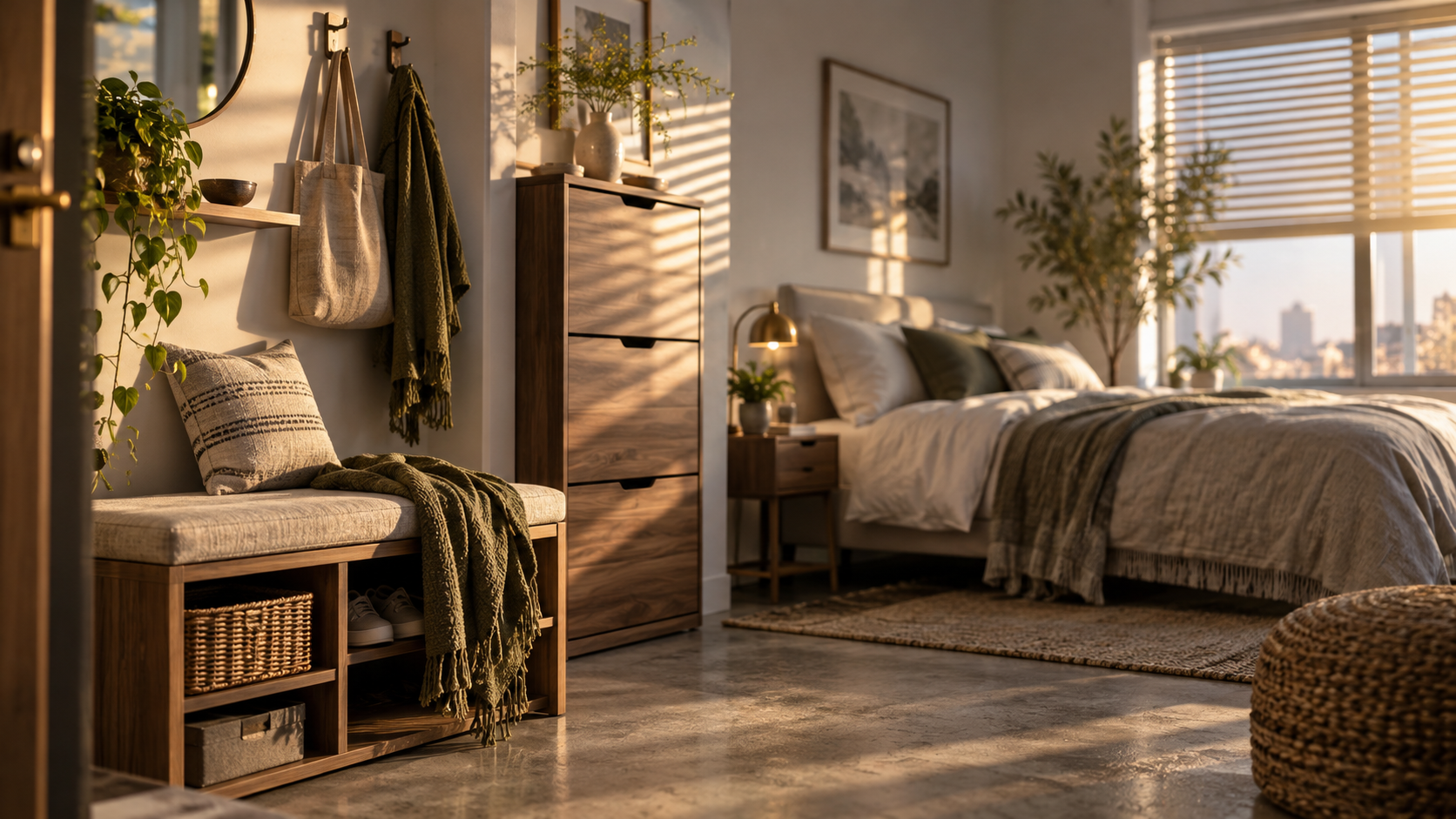
A small apartment entryway has to perform several jobs at once. It may be the place where you remove shoes, hang coats, charge devices, sort mail, store keys, and transition from the street to the rest of your home. Without a plan, these everyday tasks quickly create visible clutter. The best small apartment entryway storage ideas that look tidy combine limited furniture, consistent organization, and a calm visual arrangement.
This guide explains how to design a compact entryway that is practical without making the space feel crowded. It covers storage, furniture, lighting, security, energy use, cleaning, and sustainable materials. The goal is not to hide everything at any cost. It is to give frequently used items a convenient home while keeping walking routes, doors, and safety equipment accessible.
What Does “Tidy Entryway Storage” Mean?
Tidy entryway storage is a system in which daily-use items have designated locations, visible surfaces remain selective rather than overloaded, and the route through the entrance stays unobstructed. In a small apartment, this usually means using vertical wall space, closed or partly closed storage, and a limited number of containers.
A tidy entryway is not necessarily minimalist or empty. A basket for reusable shopping bags, a small tray for keys, and a coat hook can all be useful. The important distinction is that each item has a repeatable place and the storage matches the way you actually enter and leave your home.
Start With a Practical Entryway Audit
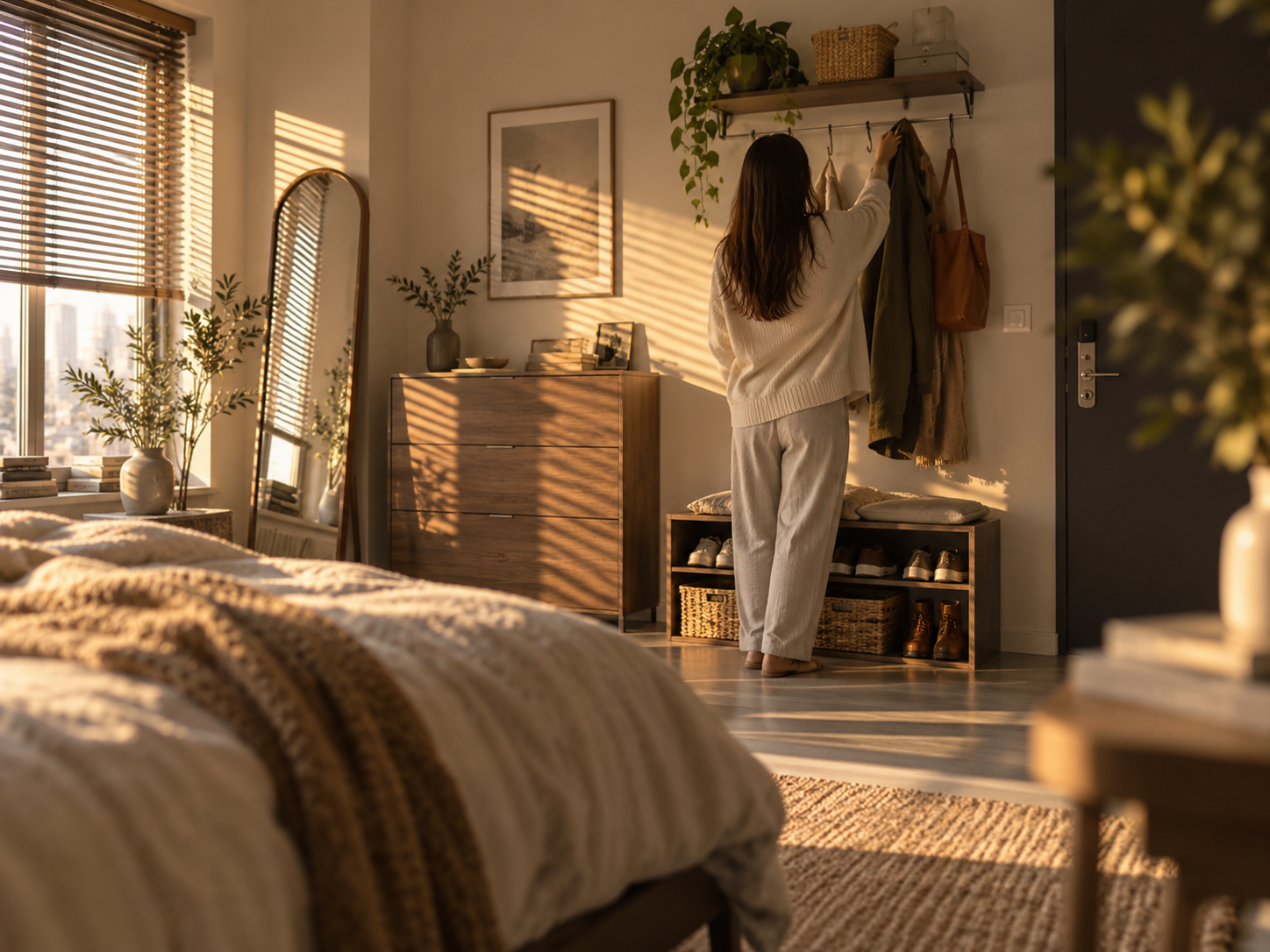
Measure the usable space
Measure the width and depth of the area, the door swing, baseboards, radiators, electrical outlets, and nearby vents. Also note whether a closet door, bathroom door, or kitchen route opens into the same space. A narrow console that looks suitable online may be impractical if it restricts the door or creates a bottleneck.
Mark the walking route with removable painter’s tape before buying furniture. Leave enough room for people to pass comfortably and for doors to open fully. If your building has accessibility requirements or you share the apartment with someone who uses a mobility aid, follow the relevant local accessibility rules rather than relying on a general furniture layout.
Track what really needs storage
For several days, note what enters the apartment. Common categories include coats, shoes, umbrellas, keys, mail, bags, pet supplies, deliveries, and charging cables. Separate daily items from seasonal or occasional items. A compact entryway should prioritize the things used every day and move the rest to a closet, under-bed container, or another room.
Choose a visual strategy
Decide whether the entryway should feel open, concealed, or layered. Open hooks make coats easy to reach but show more visual activity. Closed cabinets look calmer but require more effort to access. A combination often works well: a small number of open hooks for current-use items, with closed storage for shoes, accessories, and overflow.
Small Apartment Entryway Storage Ideas That Look Tidy
1. Use a narrow wall-mounted shelf with a catchall tray
A shallow shelf can provide a landing place for keys, transit cards, sunglasses, and other small objects without taking floor space. Add a single tray or divided container so loose items do not spread across the shelf. Keep decorative objects limited to one or two pieces; otherwise, the shelf becomes a display of clutter.
Choose a shelf with a properly rated mounting system for the wall type. A shelf fixed to a stud or installed with suitable wall anchors is safer than one attached with a fastener that does not match the wall material. Do not place heavy objects above a frequently used walking path unless the mounting instructions support that load.
2. Install a compact rail with coordinated hooks
A hook rail can hold coats, tote bags, dog leads, and umbrellas while using vertical space. For a cleaner appearance, use hooks with a similar finish and assign each person a hook or section. Keep only current-season outerwear in the entryway. Store extra coats elsewhere.
Hooks should be positioned so they do not catch clothing or interfere with the door. If children use the entryway, place a lower hook within their reach while keeping heavier items at a height that is comfortable and secure for the user.
3. Select a closed shoe cabinet instead of a large shoe rack
Open shoe racks are convenient, but several pairs can make a small entrance appear busy. A slim, ventilated shoe cabinet can conceal footwear while maintaining access. Look for doors that open in a way that does not conflict with the apartment door, and check the cabinet’s internal dimensions against your largest shoes.
Do not store damp footwear in a fully closed cabinet. Let wet shoes dry in a suitable area first to reduce odor and moisture damage. A washable tray beneath everyday shoes can also protect flooring from rain, grit, and salt.
4. Add a storage bench only when it serves two purposes
A small bench can make putting on shoes easier and may provide hidden storage underneath. In a very tight entryway, however, a bench can become an obstacle. Choose one only if its seating function is useful and its storage capacity replaces another item, such as a shoe rack or basket.
Keep the bench stable and avoid using a lightweight decorative stool as a substitute if people may lean on it. For households with pets or children, select a surface that can be cleaned without special treatment.
5. Use one tall, shallow cabinet for low-frequency items
When floor area is limited, height can provide more capacity than width. A tall cabinet can hold hats, scarves, reusable bags, cleaning cloths, or seasonal accessories. Use labeled boxes or fabric bins inside so the cabinet does not become a single deep pile.
Anchor tall furniture according to the manufacturer’s instructions, especially in homes with children or pets. The U.S. Consumer Product Safety Commission provides guidance on furniture tip-over prevention and recommends anchoring appropriate furniture to the wall. This is particularly important when drawers or cabinet doors may be opened by a child.
6. Turn the back of a door into controlled storage
Over-door organizers can hold lightweight accessories, but they are not suitable for every door. Check the clearance, hinge movement, door thickness, and weight rating. A heavy organizer can strain hinges or prevent the door from closing. Avoid blocking a fire-rated apartment door, door closer, peephole, lock, or ventilation gap.
For a rental, removable hooks or tension-based solutions may reduce wall damage, but they are not automatically safe for heavy loads. Follow the product instructions and treat adhesive hooks as light-duty storage unless the manufacturer states otherwise.
Build a Simple Entryway Organization System
Create zones by action
Organize the entrance around what happens there. A “drop” zone can include keys and mail. A “wear” zone can include coats and shoes. A “leave” zone can hold bags, umbrellas, and items that must go out. Separating these actions makes it easier to return items to the correct location.
For example, place a tray near the door for keys, a hook rail above or beside it for bags, and a shoe cabinet below or nearby. Keep outgoing mail in one labeled slot rather than several loose piles. The arrangement should be easy to use with one hand when you are carrying groceries.
Use visual limits
Set a capacity limit for each storage area. If the hook rail has room for four coats, do not treat it as a permanent home for ten. If the tray is full, sort it immediately instead of adding another tray. Physical limits prevent the system from expanding until the entryway is crowded again.
Choose a restrained material palette
Matching or complementary finishes can make several small storage pieces appear intentional. Wood, powder-coated metal, woven fibers, and recycled plastic can all work, but durability and cleanability matter more than a trend. In a high-traffic entrance, avoid delicate materials that stain easily or require frequent maintenance.
For an eco-conscious upgrade, consider furniture made from certified wood, recycled content, or durable reclaimed materials. Ask what the certification covers and whether replacement parts are available. “Sustainable” is not a guarantee of long life, low emissions, or responsible manufacturing, so compare the manufacturer’s documentation rather than relying only on marketing language.
Smart Lighting and Security Without Added Clutter
Good lighting helps a compact entryway feel orderly and makes keys, footwear, and potential trip hazards easier to see. A warm, dimmable fixture can create a welcoming atmosphere, while a brighter setting is useful when sorting mail or cleaning. Choose bulbs and fixtures with compatible dimmer and smart-home standards.
A motion sensor can turn on a light briefly when someone enters, but configure it so the light does not activate constantly when people move nearby. If you rent, a smart bulb may be easier to install than a new hardwired fixture. Confirm that the wall switch remains in the correct position and that household members can operate the light if the smart system is offline.
Entryway security devices may include a video doorbell, smart lock, contact sensor, or indoor camera aimed away from private areas. These products can improve awareness, but they also introduce privacy, account-security, and internet-dependence concerns. Use unique passwords, enable multifactor authentication when available, update firmware, and review recording and sharing settings. Check building rules and local law before recording shared hallways or neighbors.
Security equipment should not block the peephole, lock, door closer, emergency route, or access for first responders. The National Fire Protection Association, or NFPA, publishes guidance on keeping exits clear and planning for home fire safety. Its recommendations are a useful reference when arranging furniture near an apartment entrance.
Energy, Comfort, and Cleaning Considerations
An entryway is often near an exterior door, so drafts can affect comfort. A properly fitted door seal may reduce unwanted air movement, but do not modify a fire-rated door or shared building entrance without permission. If the apartment uses a smart thermostat, avoid placing its sensor where the entry door, direct sunlight, or a radiator could distort the temperature reading.
Keep smart hubs, chargers, and power strips off the floor where possible. Do not run charging cables across the walking route or under rugs. Use listed electrical products from reputable manufacturers and replace damaged cords. The U.S. Consumer Product Safety Commission offers consumer guidance on electrical safety and product recalls.
Entryway storage also affects cleaning. A robot vacuum may struggle with low furniture, loose mats, dangling cords, and narrow gaps. Choose furniture with enough clearance for your cleaning method, or plan to move a small mat and basket during cleaning. An air purifier can support general indoor air quality in the apartment, but it does not replace ventilation, source control, or professional attention to persistent dampness and mold.
Pros and Cons of Common Storage Choices
- Open hooks: Pros include easy access, low cost, and simple installation. Cons include visible clutter, dust, and limited capacity.
- Closed shoe cabinets: Pros include a calmer appearance and better visual control. Cons include reduced ventilation, more complicated access, and possible door conflicts.
- Wall-mounted shelves: Pros include floor-space savings and flexible placement. Cons include installation requirements, wall damage, and load limitations.
- Storage benches: Pros include seating and concealed storage in one piece. Cons include a larger floor footprint and a greater risk of obstructing the route.
- Smart entryway devices: Pros include automated lighting, alerts, and remote control. Cons include subscription or battery considerations, privacy risks, compatibility issues, and dependence on networks or apps.
Limitations and Common Mistakes
No storage system can compensate for having more belongings than the space can reasonably hold. Decluttering, seasonal rotation, or off-site storage may be necessary. A visually concealed pile is still a storage problem if it makes items difficult to find or creates a hazard.
Another common mistake is buying furniture before measuring. Product photos rarely show door swings, baseboards, outlet locations, or the clearance needed for cleaning. Avoid copying a showroom arrangement without adapting it to the apartment’s actual circulation.
Do not use entryway furniture to hide a leak, damp wall, damaged flooring, or an electrical problem. Address the underlying issue first. Likewise, never cover smoke alarms, fire extinguishers, sprinklers, electrical panels, or required exit signs.
A Practical Setup Sequence
- Measure and mark: Record wall lengths, door movement, outlets, vents, and the main walking route.
- Remove duplicates: Take out unused coats, damaged shoes, old mail, and accessories that belong elsewhere.
- Choose one primary storage unit: Select a rail, cabinet, shelf, or bench based on the greatest daily need.
- Add small containment: Use one tray, one mail holder, and a limited number of labeled bins rather than many loose containers.
- Install safely: Match fixings to the wall, anchor tall furniture, and keep doors, exits, and equipment unobstructed.
- Improve lighting: Add a suitable fixture or smart bulb only after confirming electrical and compatibility requirements.
- Test the routine: Enter with a bag, remove a coat, put away keys, and leave again. Adjust anything that requires awkward movement.
- Review weekly: Return misplaced items, recycle mail, rotate seasonal clothing, and check batteries or firmware for smart devices.
Concise Q&A
What is the best storage for a very narrow entryway?
A shallow wall-mounted shelf, a compact hook rail, and a slim shoe cabinet are often more suitable than a deep console. Measure first and prioritize the walking route.
How can I make open storage look less cluttered?
Limit the number of visible items, group similar objects, use matching hooks, and store seasonal belongings elsewhere. A single tray can control small loose items.
Are smart locks and video doorbells worth adding?
They can provide convenience and alerts, but the value depends on your building rules, internet reliability, privacy preferences, installation options, and ongoing costs. Review security settings before use.
How do I keep shoes from making the entryway look messy?
Set a daily shoe limit, use a washable tray, and store occasional footwear in a closed cabinet or another room. Allow wet shoes to dry before enclosing them.
Final Takeaway
The most effective small apartment entryway storage ideas that look tidy are based on accurate measurements, limited capacity, and habits that are easy to repeat. Use vertical space, conceal visual noise where appropriate, and keep everyday items within reach. Add smart lighting or security only when it improves the routine without compromising privacy, electrical safety, or access to the exit. A compact entryway does not need more furniture; it needs a clear system that fits the apartment and the people who use it.
Safety and informational disclaimer: This article provides general home-organization information, not professional architectural, electrical, fire-safety, security, or accessibility advice. Follow local building codes, lease requirements, manufacturer instructions, and guidance from qualified professionals. For safety references, consult the National Fire Protection Association and the U.S. Consumer Product Safety Commission. Product suitability varies by building, wall construction, household needs, and local rules.
Sources and Comparison Methodology
The safety comparisons in this guide were based on publicly available consumer guidance from the National Fire Protection Association (NFPA), especially its home fire-safety and clear-exit information, and the U.S. Consumer Product Safety Commission (CPSC), including furniture tip-over, electrical safety, and product-recall resources. Storage options were compared by floor-space use, accessibility, visual concealment, installation demands, ventilation, cleaning access, and potential interference with doors or exit routes. No product performance claims, prices, personal tests, or precise statistical claims are used.