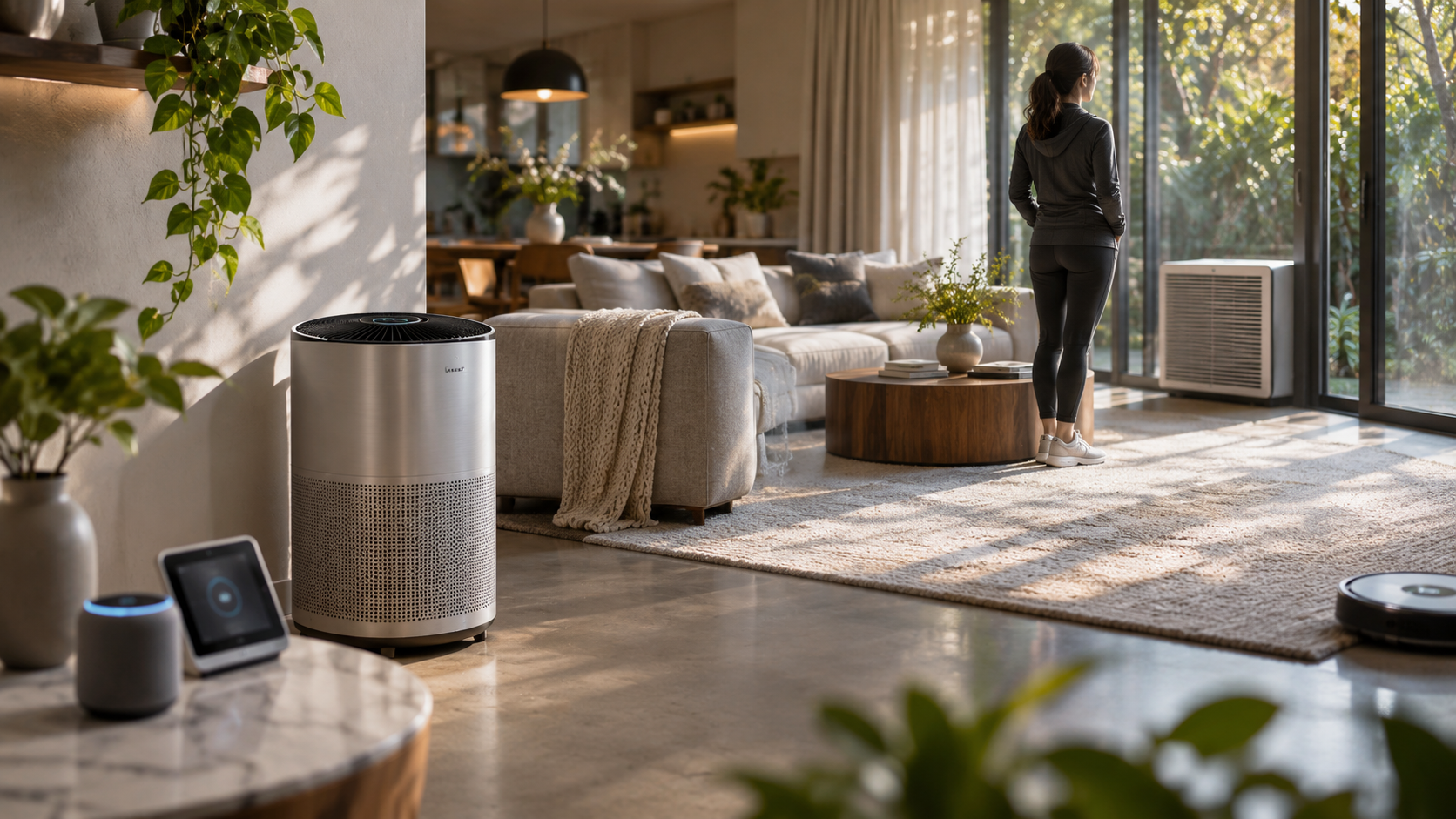
Dust is not only a cleaning problem. It is also a circulation problem. Particles enter through doors, windows, clothing, pets, packaging, and outdoor air. Once indoors, they settle on floors and furniture or become airborne again when people walk, fans run, or air moves through a heating and cooling system. Filter placement can help capture airborne particles before they spread, but a filter cannot remove dust that has already settled or correct a ventilation problem by itself.
In this guide, how to reduce dust with better filter placement means positioning and maintaining HVAC filters, portable air purifiers, and related intake points so that dusty air reaches the filter efficiently without restricting airflow or creating a safety issue. The approach works especially well when combined with sensible cleaning, source control, and smart-home monitoring.
What Better Filter Placement Means
Better filter placement is the deliberate location of a filter or filtered air intake in relation to three things: the source of particles, the direction of airflow, and the amount of air the device can safely move. A filter only works on air that passes through it. A high-quality filter placed where little air flows may be less useful than a correctly sized filter installed at a system return or in a portable purifier with an unobstructed intake.
There are three common filtration points in a home:
- Central HVAC filters: These are normally installed at the return grille or near the air handler. They protect the system and filter air circulated through the ductwork.
- Portable air purifiers: These draw room air through a pre-filter, particulate filter, and sometimes a carbon filter. Their position determines how much room air reaches the filter and how evenly cleaned air is redistributed.
- Local exhaust or ventilation filters: Kitchen hoods, bathroom fans, and balanced ventilation systems may use filters designed for their specific equipment. These should be replaced or cleaned according to the manufacturer instructions.
Adding a filter to an unapproved location, covering a vent with filter material, or stacking filters can create excessive resistance. The result may be reduced airflow, noise, poor heating or cooling performance, or damage to equipment.
Start With the Home’s Airflow
Before moving a filter, identify how air travels through the home. Locate every central return grille, supply register, portable purifier, and obvious outdoor-air intake. A return grille pulls room air back toward the HVAC system; a supply register sends conditioned air into the room. The filter generally belongs on the return side, where the air enters the equipment, unless the system documentation specifies another location.
Check whether doors, curtains, furniture, shelving, or decor block return grilles. A return that is hidden behind a sofa may pull air unevenly and leave stagnant areas where dust settles. Keep a clear area around the grille based on the equipment instructions. Do not place furniture directly over it simply because the grille is visually inconvenient.
Airflow can be observed without dismantling equipment. Hold a thin tissue near a return grille to confirm that it is drawing air inward. Do not insert objects into the grille, and do not use smoke, candles, or flammable materials for an airflow test. If several rooms remain dusty despite strong airflow at one return, the home may need additional return capacity, better air balancing, duct inspection, or professional HVAC advice.
Improve Central HVAC Filter Placement
Use the designed filter location
Most central systems have a slot at a return grille or at the air handler. Use that slot and install the filter in the marked airflow direction. The arrow on the frame should point toward the blower or equipment. A filter installed backward may not seal correctly, and its support structure may not be designed for reverse airflow.
Match the filter to the system
Filter ratings are not interchangeable labels. MERV, or Minimum Efficiency Reporting Value, describes particle-removal performance under a standardized test method, but a higher rating can also create more airflow resistance. Follow the HVAC manufacturer’s approved range, especially for older systems, compact filter cabinets, heat pumps, and systems that already have weak airflow. If the documentation is unclear, ask a qualified HVAC technician to check static pressure and compatibility.
Do not use two filters in series to create a higher rating unless the system was designed for it. A dense filter at the return plus another dense filter near the air handler can restrict the blower. It may also make filter replacement harder to track because the first filter becomes visibly dirty while the second is overlooked.
Seal gaps around the filter
Air follows the path of least resistance. Gaps around a loose filter frame can allow air to bypass the filter. Use the correct physical dimensions rather than forcing a filter into an opening. If the slot or grille does not hold the filter securely, a compatible gasketed frame or professional repair may improve the seal. Avoid improvised tape that can detach and enter the blower.
Choose a practical replacement schedule
Inspect the filter on a regular calendar or use a smart reminder, but replace it based on its condition and the manufacturer’s guidance. Construction, pets, smoking, open windows, fireplaces, and frequent cleaning can load a filter faster. A filter that looks gray or visibly clogged deserves attention, but appearance alone does not measure efficiency or airflow restriction.
Smart thermostats and HVAC monitors can help record runtime and prompt inspections. They cannot reliably determine every filter’s remaining capacity unless they use a compatible pressure or airflow measurement system. Treat an app notification as a reminder, not as proof that the filter is still performing correctly.
Place Portable Air Purifiers Where Dust Enters
A portable purifier is most useful when its intake is close enough to a particle source to capture air before it mixes throughout the room, while its outlet can distribute clean air freely. Placement depends on the room and the purifier’s airflow design.
- Entryway: A purifier near an entry area can process air affected by outdoor particles, but it should not obstruct the door or become a trip hazard. A washable mat and a place to remove shoes may reduce the load reaching the filter.
- Bedroom: Position the purifier where its intake and outlet remain clear, usually beside the bed rather than under it. Keep it away from curtains, blankets, and walls that can block circulation.
- Home office: Place the unit near the room’s active breathing and work area, but leave enough space around it for the manufacturer’s required clearance. Keep cables routed safely away from feet and chair wheels.
- Kitchen: A purifier can help with airborne particles after cooking, but it is not a replacement for a vented range hood. Grease can quickly contaminate a purifier’s filter, so do not place the unit directly beside a cooktop unless its manual permits it.
- Living area: Put the purifier in the main occupied zone or near a known dust source such as a pet bed. Avoid a corner behind furniture where the intake receives little room air.
For a single purifier, prioritize the room where people spend the most time or where particles are generated. Moving the unit between rooms may be reasonable, but it means only one room is being actively filtered at a time. A purifier with a clean-air delivery rating can help compare models, but the rating is most useful when the unit is operated at a setting that occupants can tolerate for long periods.
Coordinate Filters With Smart Home Controls
Smart lighting and atmosphere systems can support dust reduction indirectly. Lighting scenes can make dust easier to spot during cleaning, while occupancy schedules can run a purifier when a room is in use or shortly after activity. Avoid running a high-speed purifier only for a brief period if the room needs sustained air cleaning; noise, energy use, and filter wear should be considered.
Smart thermostats can circulate air on a schedule, but continuous fan operation is not automatically the best dust strategy. It may increase filtration opportunities, yet it also consumes energy and can disturb settled dust if the system has leaks, dirty ducts, or poorly balanced registers. Use the system’s circulation mode within the manufacturer’s limits and observe whether comfort, noise, and filter loading improve.
Air-quality sensors can provide useful trends, but many measure particulate matter such as PM2.5 rather than visible settled dust, fibers, or larger allergens. A low sensor reading does not mean shelves and floors are dust-free. Place a sensor away from direct purifier exhaust, open windows, cooking steam, and vents so it measures room conditions more consistently.
Smart home security systems also matter to placement decisions. Do not block cameras, door sensors, alarm keypads, or escape routes with a purifier. A device placed near an entryway should not hide a door’s locking hardware or create a cable that could be pulled during an emergency.
Pair Filtration With Source Control
Filter placement has limits because many dust particles settle quickly or are released from fabrics and surfaces. Combine filtration with measures that reduce the amount entering the air:
- Use a doormat and remove shoes at the entrance where practical.
- Wash bedding and clean upholstery according to the material’s care instructions.
- Use a vacuum with a sealed system and a suitable particulate filter, especially on rugs and upholstered furniture.
- Dust with a damp microfiber cloth so particles are captured instead of redistributed.
- Clean floors regularly, choosing a method appropriate for wood, tile, carpet, or other finishes.
- Keep windows and doors closed during local outdoor conditions that visibly increase dust, while maintaining required ventilation.
- Control humidity according to the needs of the building and occupants. Excess moisture can create separate indoor-air problems, while excessively dry conditions can increase static and discomfort.
- Keep pets’ bedding and high-traffic areas clean, and place litter boxes or similar sources away from primary air intakes.
Minimalist desk setups and organized kitchen storage can also reduce dust traps. Fewer exposed objects are easier to wipe, and closed storage keeps loose particles from collecting on rarely moved items. Home decor and furniture should still leave returns and purifier intakes accessible; a visually tidy room that blocks airflow is not a functional improvement.
Pros and Cons of Better Filter Placement
Potential advantages
- More of the room air may pass through the intended filter.
- Particles can be captured closer to active sources such as entryways, pet areas, or workspaces.
- Correctly sealed HVAC filters can reduce bypass around the filter frame.
- Smart reminders and sensor trends can make maintenance easier to track.
- Better placement may reduce visible dust on surfaces when combined with regular cleaning.
Tradeoffs and disadvantages
- Higher-efficiency filters may restrict airflow if the equipment is not designed for them.
- Portable purifiers use electricity and may produce noise, especially at higher fan speeds.
- Filters require recurring purchases or washing, depending on their design.
- A purifier can occupy floor space and may conflict with furniture, decor, pets, children, or accessibility needs.
- Filtration does not remove settled dust, gases, moisture problems, or every indoor pollutant.
Limitations and When to Get Help
Filter placement cannot compensate for a leaking building envelope, damaged ductwork, inadequate ventilation, water damage, or a malfunctioning HVAC system. Persistent dust concentrated around supply registers may indicate duct leakage, dirty ducts, damaged filters, or construction debris. Do not assume that duct cleaning is always necessary; first identify the source and ask for evidence that cleaning is appropriate for the system.
Seek qualified help if a new filter causes whistling, weak airflow, unusual equipment cycling, overheating, condensation, or a burning smell. For rental homes, follow the property manager’s rules before modifying grilles or HVAC equipment. For homes with occupants who have respiratory conditions or significant allergies, discuss indoor-air choices with an appropriate health professional and avoid treating a purifier as medical equipment.
The comparison method used in this article is based on manufacturer installation requirements, the distinction between HVAC filtration and portable air cleaning, and established indoor-air guidance from the U.S. Environmental Protection Agency, including its indoor air quality and air cleaner resources. It also follows the measurement context behind ASHRAE Standard 52.2 for HVAC filter performance. These sources support the principles of correct airflow, compatible filter ratings, and source control; they do not guarantee a specific dust reduction result in every home.
Concise Q&A
Should an HVAC filter go at the supply vent?
Usually no. The main HVAC filter normally belongs on the return side, before air reaches the equipment. A supply-vent filter can restrict airflow and should only be used when the system was specifically designed for it.
Is a higher MERV rating always better for dust?
No. A higher rating may capture smaller particles, but it can create too much resistance for some systems. Use the rating approved by the equipment manufacturer and confirm airflow if changing to a denser filter.
Where should a bedroom air purifier sit?
Place it near the occupied part of the room with its intake and outlet unobstructed. Keep it away from curtains, bedding, walls, and walkways, and follow the clearance requirements in its manual.
Can an air purifier remove dust from furniture?
No. It can capture airborne particles that pass through the filter, but it cannot clean settled dust. Damp dusting and suitable vacuuming are still needed.
Should a smart thermostat run the fan continuously?
Not automatically. Continuous circulation can increase filtration opportunities, but it may use more energy, add noise, or disturb dust. Test a reasonable schedule and monitor comfort, filter condition, and system performance.
Bottom Line
The most reliable way to reduce dust with better filter placement is to keep the central HVAC filter in its designed return location, seal the filter correctly, use an equipment-compatible rating, and place portable purifiers near meaningful particle sources without blocking their airflow. Pair those steps with entryway control, careful cleaning, organized storage, and sensible smart-home scheduling. The goal is not to place as many filters as possible. It is to create a clear, maintainable path for air to reach the right filter safely.
Safety and information disclaimer: This article provides general home-maintenance information, not medical, HVAC engineering, or personal-safety advice. Follow product manuals and local codes. Turn off power before servicing equipment, never block an emergency exit or required vent, and consult a qualified professional when airflow, electrical, combustion, water damage, or respiratory-health concerns are involved.