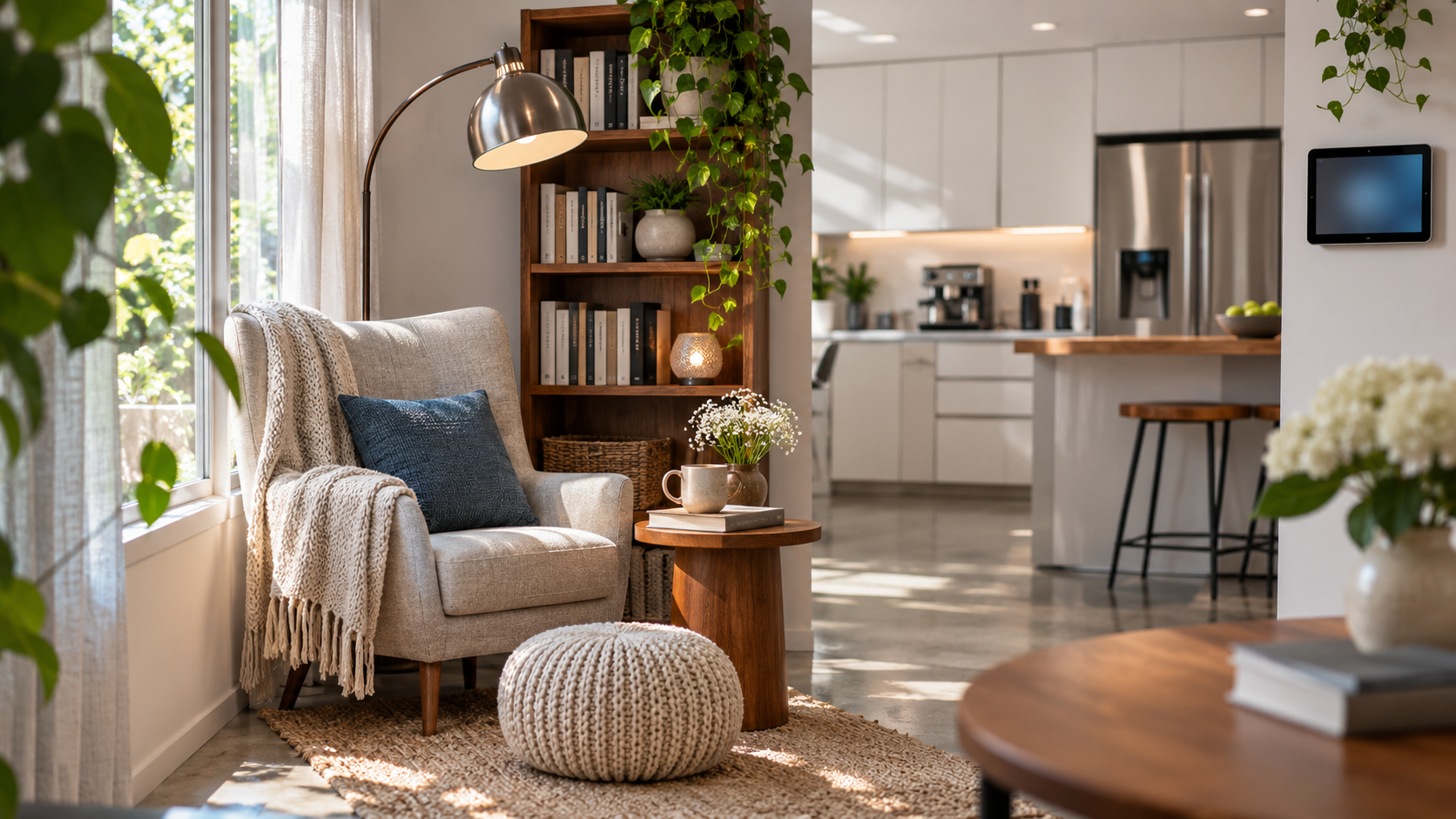
Learning how to build a reading corner in a small living room is less about finding an empty corner and more about making a compact area comfortable, well lit, and easy to keep tidy. With a suitable seat, thoughtful lighting, and a few space-saving choices, even a narrow section beside a window or sofa can become a practical place to read.
This guide explains how to plan the space, choose furniture and smart lighting, manage temperature and clutter, and avoid common layout mistakes. It also covers useful limitations and safety considerations, so the finished nook works with the rest of your home rather than feeling like an obstacle in it.
What is a reading corner?
A reading corner is a small, defined area arranged primarily for reading or quiet time. It typically combines a comfortable seat, useful light, a surface or storage for books, and enough room to sit down and get up easily. It does not need a dedicated room, a built-in bookcase, or expensive smart devices. In a small living room, the best version may be a chair and lamp placed beside an existing shelf.
The goal is to support the activity without blocking walkways, windows, doors, heating vents, or access to everyday furniture. A reading corner should feel distinct through its arrangement, not through a large collection of decorative objects.
1. Choose a location before buying furniture
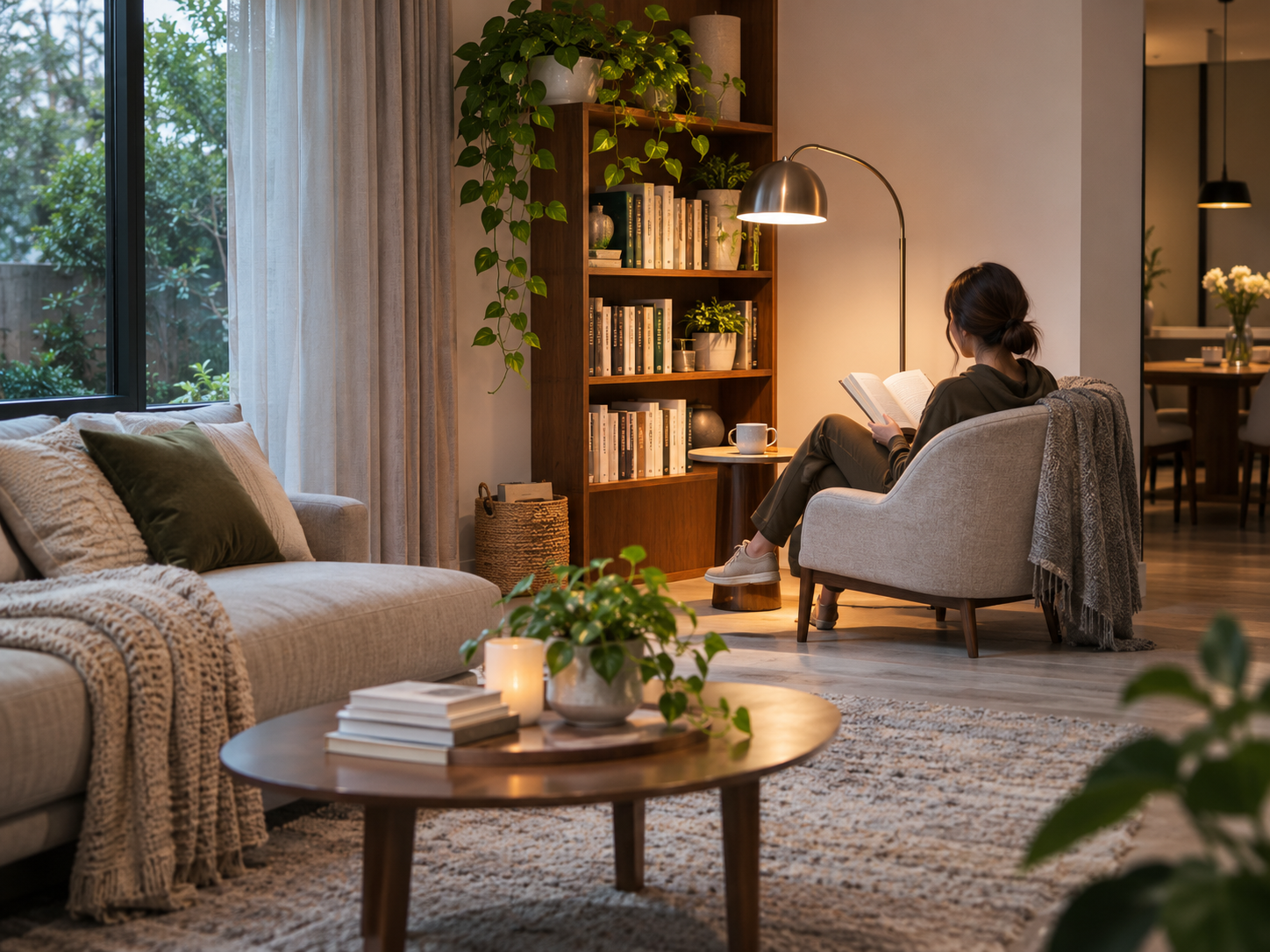
Start by observing how you use the room. Note the main walking routes between the entrance, sofa, kitchen, and any balcony or patio door. Look for a spot outside these routes, such as an unused corner, the end of a sofa, or a shallow area beside a window. Avoid placing a chair where someone must squeeze past it to reach a frequently used door.
Measure the available floor area, including the space needed to pull a chair out and move around it. Then measure the furniture you are considering. Check the seat width and depth, but also the overall footprint: a recliner, for example, may need extra space behind or in front when extended. Use masking tape to mark the chair, table, and lamp bases on the floor. This inexpensive test can reveal a cramped layout before you order anything.
Check light, outlets, and temperature
Daylight can make a corner pleasant, but direct sun may create glare or fade some fabrics over time. Try the location at the time of day you usually read. Also check whether an outlet is close enough for a lamp or charger without routing a cord across a walkway. If the only suitable place is near a radiator, supply vent, or drafty window, consider whether it will remain comfortable in different seasons.
2. Select a seat that fits the room and your reading habits
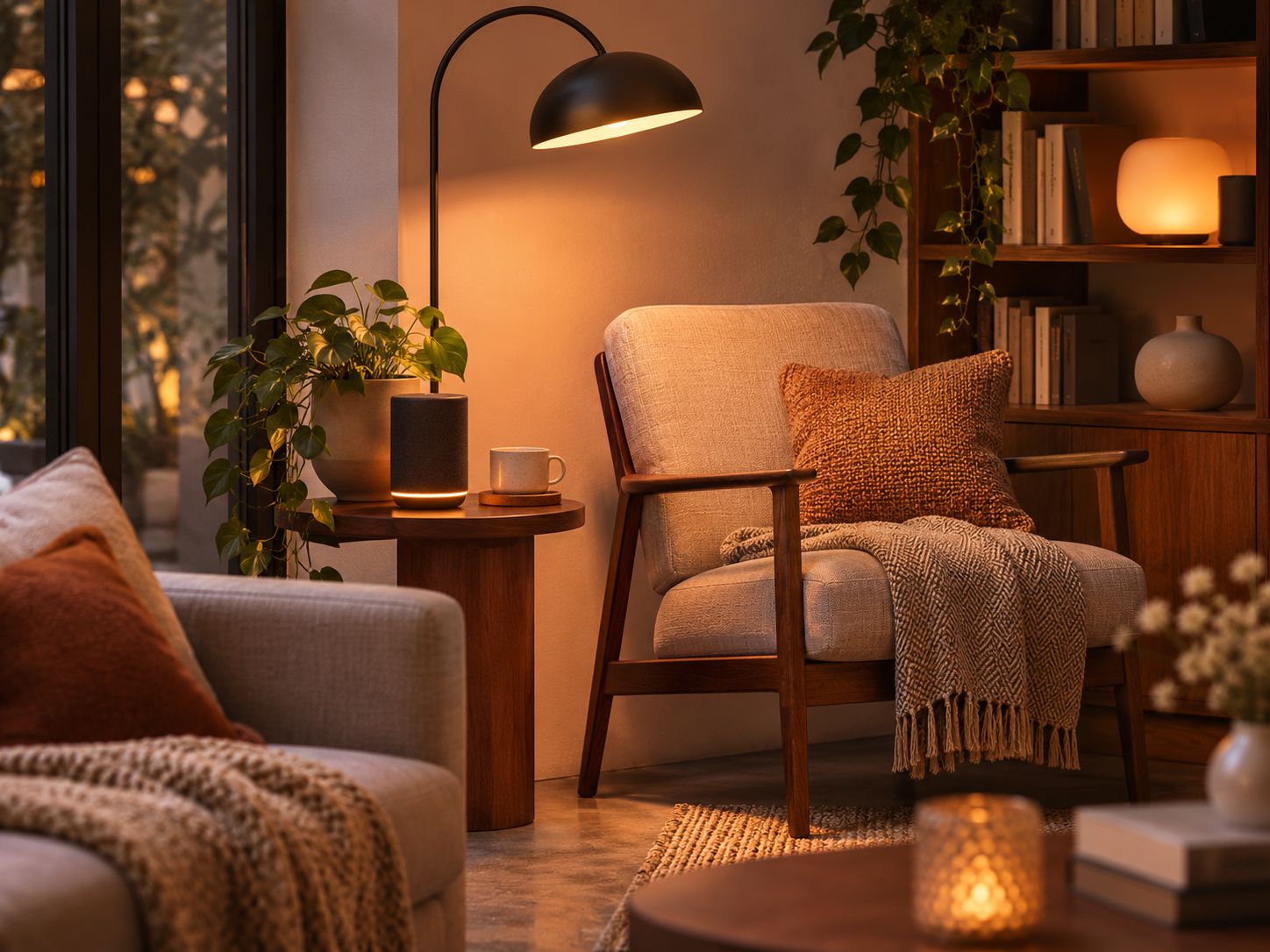
Comfort depends on fit, not simply on softness. Look for a seat that supports your usual posture and lets your feet rest comfortably. A compact upholstered chair, armless chair, small slipper chair, or supportive floor cushion can work, depending on your preferences and mobility. If you read for long stretches, test the seat when possible and consider whether its back and arms provide enough support.
A chair with visible legs can make a tight room feel less visually heavy because more floor remains visible. That is an aesthetic effect, not a promise that it will save physical space; compare the actual dimensions. A storage ottoman can serve as a footrest and hold a blanket, but it should not make the path through the room narrower. A small stool may be more flexible if it can be moved aside when guests arrive.
Choose pieces that can serve more than one purpose. A side table can hold a book and a drink, while a low shelf can provide storage and a surface for a lamp. Avoid stacking furniture simply to gain storage: an unstable arrangement is a poor trade for a little extra capacity.
3. Layer lighting for comfort and control
Good reading light should illuminate the page without shining directly into your eyes or creating distracting reflections. A directional floor lamp beside or slightly behind the seat can work well. A table lamp is an option when there is room for a stable side table. Position and shade design matter as much as the bulb: aim light toward the reading surface, and adjust the lamp so its source is not in your direct line of sight.
For a smart lighting setup, consider a dimmable smart bulb, smart plug, or lamp with built-in controls. Compatibility varies, so verify the product’s fitting, dimmer requirements, Wi-Fi or hub needs, and supported voice or app platforms before buying. Some smart bulbs should not be used with a conventional wall dimmer; follow the manufacturer’s instructions. A straightforward schedule or scene can make the lamp easy to switch on, but a manual switch should remain convenient for guests and household members.
Smart controls add flexibility, but they are not essential. A good conventional lamp may be simpler and more reliable if you do not want another app or connected device. For selection guidance, the Illuminating Engineering Society (IES) publishes lighting recommendations and educational material; its general principles can inform planning, though the ideal setup depends on the room, task, and reader. The U.S. Department of Energy also explains LED lighting and energy use. This article does not claim to have tested or ranked specific products.
Build atmosphere without sacrificing visibility
Warm-toned light can create a relaxed evening feel, while a brighter setting may be useful for detailed print or crafts. Personal comfort differs, so try a few settings rather than relying on a fixed rule. Keep ambient room lighting available if a single task lamp creates a harsh pool of light against a dark room. If a screen is part of your routine, reduce reflections and choose a comfortable brightness; smart lighting cannot eliminate eye strain or replace breaks.
4. Add small, useful storage
Use storage according to what you actually keep nearby. A narrow wall shelf can hold current books without taking floor space, provided it is installed securely and does not interfere with doors or windows. A slim bookcase may fit beside a chair, while a basket can corral a throw or a few magazines. A tray on an ottoman is useful for a drink, but remove it before using the ottoman as a footrest.
Keep frequently used items within easy reach and leave some space clear. Too many cushions, baskets, and ornaments can make a small corner harder to use and clean. If the living room already has a bookcase, consider using it rather than adding another storage unit. A tidy visual boundary—such as a small rug or a lamp—can define the nook without adding bulky furniture.
5. Coordinate the corner with the living room
A reading corner can feel intentional without matching every item in the room. Repeat one existing color or material, such as wood, a textile shade, or an accent color, to connect the new pieces to the main seating area. A small rug can mark the zone, but check that its edges lie flat and do not create a trip hazard. In a room with limited floor space, a consistent palette and open sightlines often feel calmer than several competing patterns.
Minimalist design is useful when it supports function, not when it becomes a rule that removes necessary comfort. Keep the things you use and edit out pieces that block movement or collect dust. For a more sustainable approach, consider secondhand furniture, repairable items, durable materials, or products from makers who clearly disclose materials and sourcing. “Eco-luxury” is not a standardized certification, so look for specific, verifiable claims rather than relying on a broad label.
6. Make the nook comfortable through the seasons
Room temperature can affect whether you use the space. If the corner is consistently warmer or cooler than the rest of the living room, first check for a blocked vent, draft, or direct sun. Avoid covering a thermostat or placing a heater where it could overheat nearby fabric. A smart thermostat may help manage home schedules and heating or cooling, but it does not necessarily control the temperature of one corner; performance depends on the system, sensor placement, and home layout.
Smart temperature sensors can provide readings in another part of the room, but do not assume one sensor represents every area. Follow the thermostat maker’s placement guidance and compare readings with your comfort. For energy savings, use schedules that match your household’s routine rather than making settings so restrictive that people are uncomfortable. The U.S. Department of Energy offers general guidance on home heating and cooling; actual savings vary with climate, equipment, insulation, and behavior.
For wellness, keep the corner clean and avoid using fragrances or scented devices if they bother anyone in the household. An air purifier may be useful for some indoor particle concerns, but choose one sized for the room and maintain its filters according to the manufacturer. The U.S. Environmental Protection Agency (EPA) emphasizes source control and ventilation as important parts of indoor air management; a purifier is not a substitute for addressing a pollutant source or following medical advice.
7. Keep cords and connected devices safe
Place lamps and charging cables so they do not cross walking routes or sit beneath rugs. Use products that are appropriately certified for your region, and follow their installation and load instructions. Do not overload outlets or use damaged cords. Keep drinks away from electrical equipment, and position lamps where they cannot be knocked over easily. If children or pets share the room, consider reachable controls, cord placement, and whether small accessories could be pulled down or swallowed.
A reading corner rarely needs a camera, microphone, or other security device. If you add connected devices elsewhere in the living room, review privacy settings, account security, software updates, and whether the device records audio or video. The National Institute of Standards and Technology (NIST) provides consumer information on cybersecurity and connected devices. Smart home security systems can be useful for broader home monitoring, but they should not be treated as a substitute for basic physical safety or emergency procedures.
Practical setup checklist
- Map the room: identify walkways, doors, outlets, vents, and the usual path through the living room.
- Measure the footprint: mark the proposed seat and table on the floor and test access before purchasing.
- Pick the seat: choose a size and posture that suit your body and the time you expect to spend reading.
- Plan the light: check daylight and outlet access, then select a stable lamp with suitable direction and controls.
- Keep storage compact: use existing shelves first; add only a surface or container that solves a real need.
- Test the layout: sit down, stand up, reach for a book, and walk through the room as other household members would.
- Adjust after use: notice glare, drafts, clutter, or cord problems and make small changes before adding more equipment.
Pros and cons of a small reading corner
Advantages
- Creates a dedicated place for reading without requiring a separate room.
- Can make an underused corner more functional and visually organized.
- Allows targeted lighting and convenient storage for books and reading accessories.
- Can be built gradually using furniture already in the home.
Limitations
- A small footprint can restrict seat choice and make a full-size recliner impractical.
- Daylight, room temperature, noise, and shared use may limit when the nook feels comfortable.
- Smart bulbs, sensors, and connected controls add setup, compatibility, and privacy considerations.
- Extra furniture can reduce circulation space or make cleaning more difficult if the layout is not measured.
Common mistakes to avoid
Do not buy a chair based on appearance alone; check its dimensions and comfort. Do not position a bright lamp where it causes glare, or rely on a single bulb to light both the page and the whole room. Avoid putting furniture in front of a radiator, vent, or frequently used doorway. Finally, do not assume smart devices will solve an unsuitable layout. Start with the seat, light, and walking space; add connected features only when they improve a specific part of the routine.
Q&A
How much space do I need for a reading corner?
There is no universal minimum. The required area depends on the seat and how it moves. Measure the actual furniture and preserve comfortable access through the room. A chair and wall-mounted shelf may need less floor area than a chair, side table, and floor lamp.
Is a floor lamp or table lamp better?
Either can work. A floor lamp saves tabletop space but needs a stable base and a safe position. A table lamp can be easier to control if you already have a suitable surface. Choose based on room layout, light direction, and cord access.
Do I need smart lighting?
No. Smart lighting is optional. It can offer app control, schedules, or dimming when compatible with the lamp and household setup. A conventional switch-operated lamp is often adequate and may involve less configuration.
Can I put a reading chair beside a window?
Yes, if the location remains comfortable and does not block the window or a walkway. Check for glare, drafts, direct sun, and nearby cords. Use suitable curtains or shades if daylight is uncomfortable.
Final thoughts
To build a reading corner in a small living room, prioritize a measured layout, a comfortable seat, well-aimed light, and simple storage. Make the nook fit your daily habits, then add smart lighting or temperature controls only if they solve a clear problem. A compact, flexible setup is often more useful than a larger collection of furniture and gadgets.
Disclaimer: This article provides general home-planning information, not electrical, medical, security, or energy-saving advice tailored to a specific property. Follow product instructions and local electrical and building requirements; consult a qualified professional when installation or safety is uncertain.